
Interval Running for Beginners: A 4-Week Plan Starting With 1 Minute On, 2 Off
💡 Key Summary
✅ Interval running can start as simply as alternating running and walking
✅ The talk test is the easiest way for a beginner to set effort, easier than a watch
✅ Shorten the walks first over 4 weeks, and repeat a week if it feels hard
You've heard intervals will make you faster, but picturing yourself sprinting around a track makes you want to stay on the couch, right? And if your very first try leaves you gasping, it's easy to never want to do it again. This guide is for beginners trying interval running for the first time, with a way to judge effort and a 4-week set-by-set plan.
1. What is interval running for beginners? Alternating running and walking
Your first intervals aren't "sprint hard, then rest." You run easily for about a minute, walk for a few, and repeat. The beginner plan Runner's World South Africa describes starts the same way: 1 minute of running and 3 minutes of walking, five times, for about 20 minutes.

It feels lighter than running nonstop, so it suits people just getting started. That plan treats the walking as part of the training, not just a break. New runners tend to start too fast, and the walks help keep the pace down.
| Comparison | Continuous running | Run-walk intervals |
|---|---|---|
| How it goes | No stopping | Short runs, then walks |
| Early difficulty | Higher | Lower |
| Catching your breath | While running | During the walks |
| Best for | Already runs 20+ min | Just starting out |

One minute is plenty to start. Let's run until the timer beeps!
2. Setting interval effort with the talk test
For beginners, the simplest gauge is how your breathing feels. The US Centers for Disease Control and Prevention (CDC) says that at moderate intensity you can talk but not sing, and at vigorous intensity you can't say more than a few words without pausing. For beginner intervals, keep your run segments at the level where your sentences don't break up.
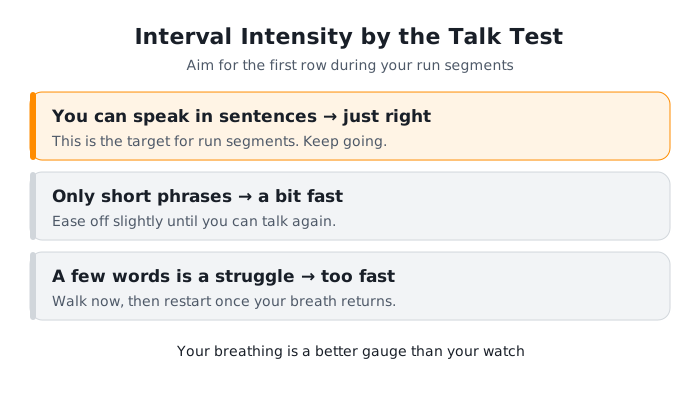
Research roughly backs this feeling up. A 2022 systematic review pooling 10 studies, mostly of heart patients, found that the last stage where people could still speak comfortably matched the first ventilatory threshold. But the studies were patient-focused and their methods varied, so we can't say it applies exactly to healthy beginner runners.
Effort scales also differ by source, so don't cling to the numbers. Runner's World South Africa describes walking as about a 2 out of 10 and running as about a 3 or 4. The CDC puts moderate intensity at 5 or 6, so the scales themselves differ.
| Signal | Meaning | What to do |
|---|---|---|
| You can speak in sentences | Right intensity | Keep going |
| Only short phrases | A bit fast | Slow down |
| A few words is hard | Too fast | Walk right away |
💡 Tip
If you're huffing and puffing, it's fine to walk for 30 seconds or more, whatever the plan says. Runner's World South Africa also treats this "huff and puff test" as a cue to walk.
3. A 4-week set-by-set example
The table below is a 4-week example the Wittiz team built to follow the progression logic of that beginner plan. Runner's World South Africa normally spends 3 to 4 weeks on each step, so this table is on the quicker side. If it feels hard, repeat the same week once more.
| Week | Run | Walk | Rounds |
|---|---|---|---|
| Week 1 | 1 min | 3 min | 5 |
| Week 2 | 1 min | 2 min | 6 |
| Week 3 | 2 min | 2 min | 5 |
| Week 4 | 3 min | 2 min | 4 |
Each session follows the same order. By our math the work portion is around 20 minutes, and about 30 minutes with the warm-up and cool-down.
- 5 minutes of walking and light movement to warm up
- Run and walk as the table says
- 5 minutes of walking to finish
- 2–3 sessions a week, with rest days in between
⚠️ Caution
If you feel chest pain, dizziness, a cold sweat, or unusual breathlessness, stop right away and see a doctor. If you have heart disease, high blood pressure, asthma or another condition, or you're returning to exercise after a long break, check with a medical professional first. And if a joint or muscle starts to stab, end the session there.
4. How to keep interval running going
Runner's World South Africa suggests finishing a session feeling you could have done a little more. Novice runners also get hurt more often than experienced ones, so even if you're eager, don't race ahead of the table. If you're worried about injuries, read How to Run for the Long Haul Injury-Free: From Preventing Knee Pain to Recovery for warm-up and cool-down tips too.
| Situation | What to do |
|---|---|
| Run segments feel too hard | Cut the run to 30 seconds |
| It's easy every time | Move up a week early |
| You skipped a few days | Repeat the last week once |
If you can already run about 20 minutes without stopping, move on to the interval intro in An 8-Week Plan to Finish a 10K: From Beginner to Your First 10 Kilometers. To see your numbers, How to Use a Running App Smartly: A Complete Guide to GPS, Pace, and Heart Rate explains how to read pace and heart rate.
A plan you can see feels much lighter. In the Wittiz app, set a goal like "2 interval sessions this week," then check your report to see how consistently you ran, walking segments included. The jelly you earn lets you dress up Moongti, and a cheer from a friend can get you out the door once more.

Walking counts as training, too. Let's catch our breath and do one more set!
Frequently Asked Questions (FAQ)
How many times a week should I do interval running?
Two to three times a week is about right at first. Runner's World South Africa also suggests run-walk training on 2 to 3 days a week. Always leave rest days in between.
Will I be really out of breath when I start intervals?
If your words break up during the run segment, you're going too fast. Slow down or cut the run to 30 seconds. The talk test is the easiest guide.
Is the morning the best time for interval running?
The time of day matters less than a time you can stick to. If mornings leave you stiff, wake your body up with a walk first, and if you run in the evening, leave a gap after eating.
Wrapping Up
Interval running starts with alternating 1 minute of running and walking, and you set the effort with the talk test. Repeating a week to fit your body is good progress, too, so don't feel you have to follow the table exactly.
This week, just try 1 minute of running and 3 minutes of walking, five times. Moongti will run right beside you to the sound of the stopwatch!
Try it for yourself in the Wittiz app!

References
- Runner's World South Africa. How to Start a Run/Walk Programme
- CDC. Measuring Physical Activity Intensity
- Vieira AM et al. (2022). Application and Measurement Properties of the Talk Test in Cardiopulmonary Patients: A Systematic Review. Reviews in Cardiovascular Medicine
This article was written by the Wittiz team and includes app-related content. If you have pain or an existing medical condition, or you feel unwell while running, please be sure to consult a medical professional.