
Is Running Bad for Your Knees? What the Research Really Says
💡 Key Summary
✅ In research, recreational runners had a lower rate of hip and knee arthritis than non-runners
✅ To look after your knees: raise weekly mileage by 10% or less, take rest days, and add strength work
✅ Never push through pain that keeps coming back. See a doctor first
"Keep that up and your knees will be shot." You've probably heard it, haven't you? And if you're about to start, you might worry about wearing out your joints, or if you already run, every twinge can feel like a warning. This guide is for anyone who wants to know what research says about running and your knees, with the key findings and practical ways to protect them.
1. Is Running Really Bad for Your Knees? What the Research Says
The short answer: "There's little evidence that recreational running harms your knees."
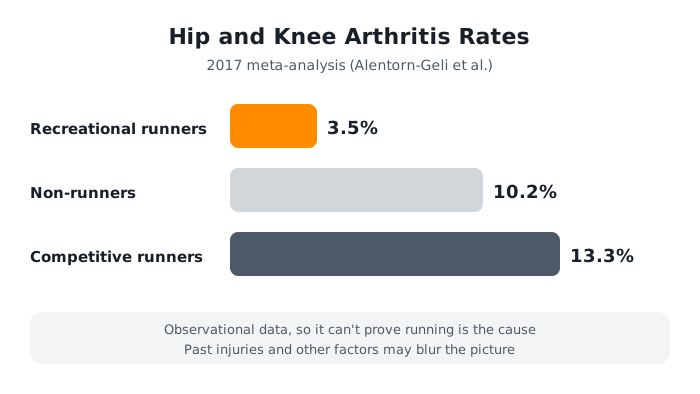
A 2017 meta-analysis by sports medicine researchers pooled 25 studies (about 125,000 people). Using 17 of them (about 115,000 people), they found hip and knee arthritis in roughly 3.5% of recreational runners, 10.2% of non-runners, and 13.3% of competitive runners.

| Group | Arthritis rate | In plain words |
|---|---|---|
| Recreational runners | About 3.5% | The lowest |
| Non-runners | About 10.2% | The reference group |
| Competitive runners | About 13.3% | The highest |

Runners had less arthritis? Surprising! Let's look at the story behind the numbers.
But these are observational comparisons, so they can't prove that running protects your joints. The authors said they couldn't tell whether running itself or other factors explained the pattern. Things like past injuries can easily blur the picture.
2. Does Running More Mean More Risk? Volume and Years
In the same analysis, runners with under 15 years of running had a weaker link to arthritis than non-runners (odds ratio 0.6). Those who ran at high volume and intensity for a long time showed a link to arthritis. Again, it's unclear whether that's cause or coincidence.
Another 2017 meta-analysis found mixed results across studies. Runners were less likely to have knee replacement surgery in one pooled result, yet the authors concluded the evidence wasn't strong enough to pin down running's role. So the honest answer is "no proof it harms, no proof it protects."
- If you run 2–3 times a week for fun, there's little reason to avoid it for your knees' sake
- If you've had knee surgery or an arthritis diagnosis, talk to your doctor first, since cases vary a lot
- If you keep pushing mileage and pace, plan recovery and rest at the same time
💡 Tip
The more you worry about your knees, the more "how long you keep going" matters over "how fast." Starting slowly and sticking with it is better for both your knees and your habit.
3. Four Ways to Protect Your Knees While Running
A sports medicine physician at Cleveland Clinic says knee injuries usually come from building up too fast, too soon rather than from running itself. Here are the practical points from the Cleveland Clinic article.
| Point | What to do | Guideline |
|---|---|---|
| Adding distance | Small steps each week | 10% or less per week |
| Running shoes | Replace on time | 480–800 km (300–500 mi) |
| Strength and mobility | Work on rest days | 1–2 light sessions a week |
| Rest | Space out your runs | Avoid back-to-back runs |
Not sure how to choose shoes? Start with How to Choose Your First Running Shoes. If you want a warm-up and cool-down routine, see the injury prevention guide. Softer trails are easier on the joints but add a tripping risk, and treadmills are relatively gentle.
⚠️ Caution
If your knee is swollen and warm, you can't put weight on it, or an aching pain keeps you up for days, stop running and see an orthopedist or sports medicine doctor. Pushing through pain isn't a solution.
4. A Knee-Friendly Running Week to Start With
The idea is simple: increase slowly within pain-free limits, and build rest days into your plan. If you're just starting, the 8-week plan in the Beginner's Guide to Running is a good place to begin.

| Day | What to do | Knee check |
|---|---|---|
| Mon | 20-minute easy run | No pain afterward |
| Wed | 20-minute run or run-walk | No twinge on stairs |
| Fri | Rest or 15 min strength | Only muscle tiredness |
| Sun | 25-minute easy run | No swelling next day |
What the research really points to is consistency. Set a count goal like "3 times a week" in the Wittiz app, then check your report to see how many times you ran last month. If you fill the count instead of forcing distance, Moongti grows, and the jelly you collect lets you dress Moongti up.

Knee feeling twinge-y? Today is a rest day! Rest is training too. See you tomorrow!
Frequently Asked Questions (FAQ)
Does running for years wear out your knee cartilage?
For recreational runners, the evidence for more arthritis is weak. The effect of years of high-volume, high-intensity running varies across studies and isn't settled. If pain persists, cut back and see a doctor.
Can I run if my knees aren't great?
If you've had knee surgery or an arthritis diagnosis, it depends on your condition, so check with your doctor first. With the green light, start short and rest well between runs. Stop right away if pain grows.
Is walking better than running when my knee hurts?
If it hurts, walk only within a pain-free range. If walking feels fine, a run-walk mix can be a gentle start. If everyday walking still hurts, get it checked first.
Wrapping Up
If you run for fun, there's no need to worry about your knees more than necessary. Build up slowly, keep your rest days, and never ignore pain signals.
This week, try just two pain-free 20-minute runs. Moongti will be right there looking after your knees with you!
Try it for yourself in the Wittiz app!

References
- Alentorn-Geli E et al. (2017). The Association of Recreational and Competitive Running With Hip and Knee Osteoarthritis: A Systematic Review and Meta-analysis. JOSPT
- Timmins KA et al. (2017). Running and Knee Osteoarthritis: A Systematic Review and Meta-analysis. The American Journal of Sports Medicine
- Cleveland Clinic. Is Running Bad for Your Knees?
This article was written by the Wittiz team and includes app-related content. If you have knee pain or a history of joint surgery or arthritis, please don't push yourself, and be sure to consult a medical professional.