
Running Benefits and Longevity: What Once-a-Week Running Studies Show
💡 Key Summary
✅ Several observational studies found that runners have a lower risk of dying than non-runners
✅ Small amounts, like 1–2 runs and under 51 minutes a week, showed a similar pattern, and more running didn't mean proportionally more benefit
✅ These studies can't prove cause and effect, so consistency matters more than an extreme goal
"Running is good for you." You've heard that a hundred times, right?
But "how much do I actually need to run?" is harder to answer. This guide is for busy runners curious about the benefits of running, with two key studies on running and mortality explained simply.
1. What Does the Research Say About Running Benefits?
Let's put the two studies side by side. One followed a large US adult cohort, and the other pooled several cohorts in a meta-analysis. Both are observational studies that tracked people's lives over many years.

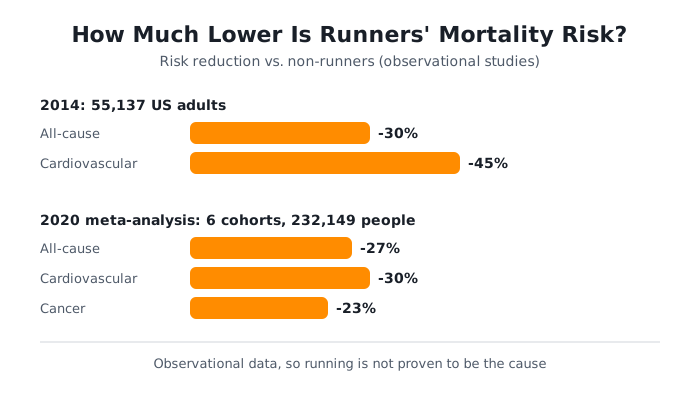
In 2014, Lee and colleagues followed 55,137 adults aged 18 to 100 for about 15 years on average. Runners had a 30% lower risk of dying from any cause and a 45% lower risk of cardiovascular death than non-runners. The authors translated this into roughly 3 extra years of life expectancy.
| Study | Who | Runners' mortality risk |
|---|---|---|
| 2014 Lee et al. | 55,137 adults | All-cause 30% lower, CVD 45% lower |
| 2020 Pedisic et al. | 232,149 people, 6 cohorts | All-cause 27%, CVD 30%, cancer 23% lower |
The second study pooled 14 studies with follow-up ranging from 5.5 to 35 years. There were 25,951 deaths in total. Seeing the same direction across several groups is the strength of this analysis.

Big numbers, but remember they're averages across groups of runners.
2. Does Running Once a Week, Under 51 Minutes, Still Count?
The most striking part of the Lee study is the small amount. People who ran 1–2 times a week, under 51 minutes a week, and under 6 miles (about 9.7 km) still had lower mortality than non-runners. When running time, distance, frequency and speed were split into five groups, the groups didn't differ much.

The 2020 Pedisic meta-analysis agreed. It found no clear dose-response trend for weekly frequency, duration, pace or total volume. The authors concluded that more people running, at any dose, would likely benefit population health.
💡 Tip
On a busy week, aim for "20 minutes, twice." The lowest-dose group in the research was already under 51 minutes a week.
3. Does Running More Mean Living Longer?
Not according to either study. Benefits didn't keep rising in a straight line as running increased. But that doesn't mean "lots of running is safe." It means "these studies didn't find a difference."
| Caution when reading | Why |
|---|---|
| Don't assume cause | Observational data shows association only |
| Self-reported | The Lee study used a questionnaire |
| Healthier people may run more | Runners may have been healthier to begin with |

Keeping at it matters more than running a lot. What a relief!
In the same Lee study, people who kept running over time had a 29% lower all-cause and 50% lower cardiovascular mortality risk. In other words, those who stuck with it did better than those who quit. For habit-building tips, see Running Habit 30-Day Challenge.
⚠️ Caution
If you have heart disease, high blood pressure or diabetes, or you've been inactive for a long time, talk to a doctor before you start. If you feel chest pain, dizziness, a cold sweat or sudden breathlessness while running, stop right away and get help.
4. How Do You Use This in Your Own Running?
The research doesn't promise a perfect plan. It says it's not too late to start. If you're new, mix walking and easy running as in Beginner Running Guide, and if weight management is your goal, see Running Diet Guide.

- Frequency first: fill 2 runs this week
- Keep it short: 20–30 minutes is plenty
- Rest is fine: if you skip a week, restart next week
Running's benefits can't be judged by mortality alone. Mood, sleep and fitness are part of the picture too. That's why this guide uses "an amount you can keep doing" as its yardstick rather than a lifespan number.
The takeaway is "how consistently," not "how fast." In the Wittiz app report, check how many times you ran last month. Set a realistic goal like "twice a week," and enjoy dressing up Moongti with the jelly you earn for every run.
Frequently Asked Questions (FAQ)
Is running just once a week worth it?
In observational studies, people who ran 1–2 times a week, under 51 minutes, had a lower risk of death than non-runners. That's an average pattern and doesn't guarantee the same effect for you.
Does running more help you live longer?
In both studies, benefits didn't clearly grow in proportion to running volume. That isn't evidence that very high volume is safe, so adjust to how your body feels.
Can we say running extends lifespan?
No. These are observational studies and can't prove running is the cause. Healthier people may also run more, so we can only say there is an association.
Wrapping Up
Even small amounts of running show up alongside better health outcomes, and what matters most is keeping it up. Just remember these are observational results.
This week, try two easy 20-minute runs. Moongti will be right there running with you!
Try it for yourself in the Wittiz app!

References
- Lee DC et al. (2014). Leisure-time running reduces all-cause and cardiovascular mortality risk. J Am Coll Cardiol
- Pedisic Z et al. (2020). Is running associated with a lower risk of all-cause, cardiovascular and cancer mortality, and is the more the better? Br J Sports Med
This article was written by the Wittiz team and includes app-related content. If you have heart disease, high blood pressure or another health condition, or feel chest pain or dizziness while running, please be sure to consult a medical professional.