
Carbon Plate Running Shoes for Beginners: Worth It, Risks, and When to Start
💡 Key Summary
✅ In lab studies, carbon plate shoes improved running efficiency by about 3% on average, mostly in fast, experienced runners
✅ For beginners, cost, shorter lifespan and extra calf and Achilles load make a daily trainer the easier first pair
✅ If you run steadily and have a goal, try carbon shoes for races and key workouts, starting with short runs
You've probably heard that carbon shoes make you faster. But if you've only been running for a few weeks, it's hard to tell whether they're meant for you. This guide is for new runners who are curious about carbon plate shoes, covering what research shows, what to watch for, and when it makes sense to start.
1. What does research say about carbon plate shoes?
Carbon shoes pair a carbon-fiber plate with a bouncy foam in the midsole. A meta-analysis by Kobayashi and colleagues (2026, Frontiers in Sports and Active Living) pooled 13 crossover studies and 271 runners. Running economy, the energy you spend at a given speed, improved by about 2.9% on average, and the authors rated the certainty of evidence as moderate.
Still, you can't drop that number straight into your own race time. The studies come with limits, as the table shows.
| What was checked | Finding | Keep in mind |
|---|---|---|
| Running economy | About 2.9% better | Lab conditions |
| Participants | Mostly men, ages 18–45 | Few women or beginners |
| Shoe comparison | Plate and foam changed together | Not the plate alone |
| Injury | Not measured directly | Not proof of safety |
A 2026 systematic review in BMC Sports Science, Medicine and Rehabilitation (Alexe and colleagues) saw a similar pattern. Shoes combining a plate with resilient foam showed 2.6–4.2% gains, but softening only the plate's stiffness changed things by about 0.55%, which wasn't significant. In other words, the whole shoe package matters, not just the carbon plate.

I get that they're fast, but were beginners like me in those studies?
2. What should beginners watch out for?
A benefit on average doesn't mean every runner gains the same. The training site TrainingZones notes that runners slower than about 6:00 per km see little measurable speed gain and mostly feel extra cushioning. Individual responses vary a lot, so the same pair can feel great to one runner and odd to another.
Cost and lifespan matter too. The same guide says the foam wears out faster, roughly 300–500 km versus 700 km or more for a standard trainer, and prices run around €200–350 or more (about $220–380). Here's how the two compare.
| Daily trainer | Carbon shoe | |
|---|---|---|
| Main use | Everyday easy runs | Races, key workouts |
| Lifespan (approx.) | 700 km or more | 300–500 km |
| Price | Lower | Higher |
| Adjustment | Barely any | A few runs to adapt |
📌 Note
Many guides warn that switching suddenly can shift load onto the calves and Achilles tendon. But no study has directly compared injury rates, so we can't call these shoes risky or safe. Giving yourself an adjustment period is the most practical precaution.
If you're still building toward your first 5K or 10K, steady mileage matters more than a pricey pair. For the basics of choosing shoes, see How to choose beginner running shoes.
3. When and how should you start?
The test isn't how fast you are. It's how consistently you've been running and how your body feels. If you pass all three checks below, trying one pair is reasonable. The numbers are a rule of thumb for beginners, not research findings.
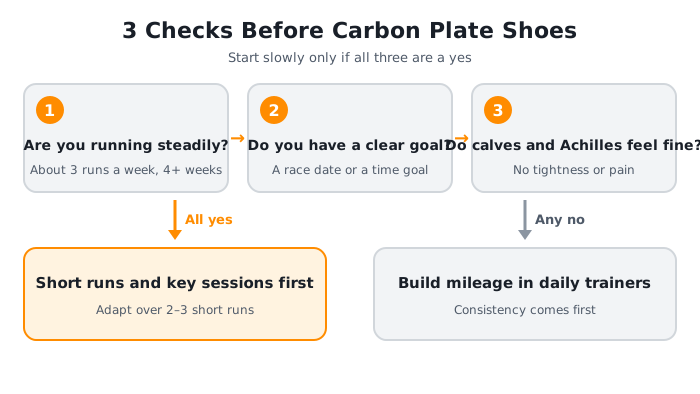
If every answer is yes, this order works well.
- Start with short runs: For the first 2–3 runs, go easy and short and notice how your calves feel.
- Races and key workouts only: Don't wear them daily; alternate with your trainers.
- Build distance slowly: Stay within your usual distance while you adapt.
- Jot it down: Note the days you wore them and how they felt, so you can compare later.
⚠️ Caution
If your calves or Achilles feel tight during or after a run, or your first steps in the morning feel stiff, stop wearing the carbon shoes and go back to your daily trainer. Pain that makes it hard to put weight on your foot, or swelling and warmth that lasts, is a reason to see an orthopedic or sports medicine doctor. If your arch bothers you, see Plantar Fasciitis Stretches for Runners too.
That's about as far as shoes need to go; leave the rest to consistency. Set a weekly run-count goal in the Wittiz app, then check your report to see how distance and pace held up over the month. Writing down the day you switch shoes makes the change easy to compare, and the jelly you earn per kilometer lets you dress up Moongti along the way.

Going out together matters more than fancy shoes. Comfy pair on, easy run today!
Frequently Asked Questions (FAQ)
Will carbon plate shoes make a beginner faster?
On average, efficiency improved in studies, but most participants were fast, experienced runners. At slower paces the gain can feel small, and individual differences are large. If a faster time is your goal, consistent training like the 10K 8-week plan comes first.
Can I wear carbon shoes every day?
That's not the usual advice. The foam wears out sooner and the calves and Achilles can take extra load, so most runners save them for races and key workouts and alternate with a daily trainer.
Do carbon shoes increase injuries?
No study has compared injury rates directly, so we can't say the risk is higher or lower. If something feels off, switch back to your usual shoes right away, and see the running injury prevention guide for the basics.
Wrap-Up
Carbon shoes are something to think about after you run steadily and have a goal.
This week, just focus on easy runs three times in the shoes you already have. Pick the fancy pair later, slowly, and Moongti will run right beside you!
Try it for yourself in the Wittiz app!

References
- Kobayashi EN, de Toledo RRF, de Almeida MO, et al. (2026). Metabolic effects of carbon-plated running shoes: a systematic review and meta-analysis. Frontiers in Sports and Active Living
- Alexe CI, Choudhary PK, Choudhary S, et al. (2026). Emerging sports footwear technologies and their effects on running economy, biomechanics, and performance: a systematic review. BMC Sports Science, Medicine and Rehabilitation
- TrainingZones. Carbon Plate Running Shoes: Do They Actually Work?
This article was written by the Wittiz team and includes app-related content. If you have calf, Achilles or foot pain or an underlying condition, please don't push through it and be sure to consult a medical professional.