
Easy Run Pace Guide: How Slow to Run and the 80/20 Rule
💡 Key Summary
✅ An easy run is a pace where you can still speak in full sentences
✅ Well-trained athletes do about 80% of their training at low intensity
✅ Truly easy days are what make your hard days count
"Run slow to run long" — you've heard it, but once you're out the door, you keep speeding up, don't you? Before long every run leaves you out of breath, and easy days and hard days blur together. This guide is for runners who find an easy run pace hard to hold, with a simple way to find it and a plain-English look at the 80/20 rule.
1. Find your easy run pace with the talk test
An easy run is a run at a pace where you can chat comfortably. The U.S. CDC says that at moderate intensity you can talk but not sing, and at vigorous intensity you can't say more than a few words without pausing for breath. Easy running sits comfortably on the relaxed side of that line, where your sentences don't break.

The running site Endorphins says the same: you should be able to hold a conversation, and gasping out a few words means you're going too hard. It adds that your easy pace won't match anyone else's, because fitness, age, terrain, weather, and recovery all play a part.
| Signal | What it means | What to do |
|---|---|---|
| You speak in sentences | Easy pace | Keep going |
| Only short phrases | A bit fast | Ease off |
| A few words is a struggle | Too fast | Walk, catch your breath |

If we can chat the whole way, it's perfect. If the words stop, let's slow down a little!
2. Easy 80%, hard 20%: the 80/20 rule
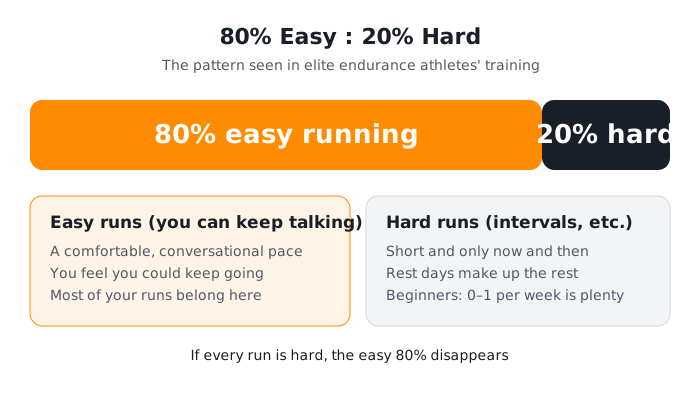
The 80/20 rule means doing most of your training easy and only a small part hard. It comes from sport scientist Seiler's 2010 paper: national and international-level endurance athletes training 10 to 13 times a week did about 80% of sessions at low intensity and about 20% at high intensity.
There's trial data too. Stöggl and Sperlich split 48 well-trained runners, cyclists, triathletes, and cross-country skiers into four groups for nine weeks, and the group using mostly low intensity plus some high intensity gained the most in peak oxygen uptake. But these were already well-trained athletes, so we can't say beginners would get the same result.
💡 Tip
If you're new, skip the math and start with "2–3 of my 3 weekly runs at a talking pace." You don't need a hard day at all. Easy runs alone are plenty to build the habit.
3. What to do when your easy runs keep getting faster
Slow running isn't hard because you lack willpower. On a good day your legs feel light, and a number on your watch can stir up a little competitiveness. So it's easier to use feel, not speed, as your guide.

| Situation | What to do |
|---|---|
| You start too fast | Jog like you're walking for 5 min |
| You feel slow next to friends | Match the talking pace |
| Your watch number nags you | Watch your breathing instead |
| It feels too slow | Add 5 minutes of time |
⚠️ Caution
If you feel chest pain, dizziness, a cold sweat, or unusual shortness of breath while running, stop right away and see a doctor. If you have a heart condition, high blood pressure, or asthma, check with a medical professional before you start. And if a joint hurts sharply even at a slow pace, call it a day.
4. Plan your easy runs for this week
You don't have to copy elite athletes' 80/20 exactly. As a beginner, build up frequency and time with easy runs first, then layer intervals on top. Here's an example from the Wittiz team.
- Run 3 times a week, 20–30 minutes each
- Start all 3 at a talking pace
- Once comfortable, swap just one for an interval run
- After each run, ask yourself, "Could I have done more?"
If you want to see pace as a number, how to use a running app shows how to read it. To build up step by step over eight weeks, the 10K 8-week training plan is a natural next read.
Your records can tell you whether easy days really were easy. In the Wittiz app, set a goal like "run 3 times this week," then check your report to see how steady your pace stayed compared with last week. Easy days still earn jelly to dress up Moongti, and a cheer from a friend can get you out for one more.

Slow today, but all the way! Moongti grows on slow runs too.
Frequently Asked Questions (FAQ)
How slow should an easy run be?
Slow enough that you can speak in full sentences without breaks. There's no fixed number, because pace varies a lot from person to person. Age, terrain, and weather matter too, so use your breathing as the guide.
Will running slowly really improve my times?
In studies of well-trained athletes, mostly low intensity plus some high intensity did well. That doesn't confirm the same for beginners, though. What is clear is that easy running is simply easier to keep doing.
How long should an easy run be?
Twenty to thirty minutes is plenty to start. If you finish feeling like you could do a bit more, the length was right. Mixing in walking is fine too.
Wrapping Up
The yardstick for an easy run isn't a number, it's breathing that lets you keep talking. Keep easy days truly easy, and your hard days will go better too.
This week, run all three runs at a talking pace. Moongti will chat with you the whole way!
Try it for yourself in the Wittiz app!

References
- Seiler S. (2010). What is best practice for training intensity and duration distribution in endurance athletes? International Journal of Sports Physiology and Performance
- Stöggl T, Sperlich B. (2014). Polarized training has greater impact on key endurance variables than threshold, high intensity, or high volume training. Frontiers in Physiology
- CDC. Measuring Physical Activity Intensity
- Endorphins Running. How Slow Should Easy Runs Be?
This article was written by the Wittiz team and includes app-related content. If you have pain or a medical condition, or feel unwell while running, please be sure to consult a medical professional.