
Restarting Running After a Month Off: How to Ease Back In
💡 Key Summary
✅ A break of two weeks or less costs little fitness, but past a month the drop is real
✅ The longer you've been off, the lower you restart: about 60–70% of your usual distance
✅ For the first two weeks, run-walk three times a week and forget your old times for now
"I'll just take a month off and get right back to it" — and then two months slip by. Now you're standing at the door, lacing up, and wondering if you can still run like before. This guide is for runners restarting after a month or more off, with how much fitness you lose and how to come back without getting hurt.
1. How much fitness do you lose in a month off?
Short answer: a short break costs less than you fear, and a long one costs real fitness. A sports medicine review (Mujika & Padilla, 2000) found that even under four weeks of training cessation, well-trained athletes show a fast drop in VO2max and blood volume. The changes are milder in people who only recently started training.

Numbers help. These are figures summarized by the coaching site RunnersConnect, not the original studies, so treat them as rough guides that vary from person to person.
| Time off | VO2max change | In short |
|---|---|---|
| Up to 10 days | Barely changes | Don't worry |
| 2 weeks | About 6% lower | A few runs fix it |
| 9 weeks | About 19% lower | Build slowly |
| 11 weeks | About 25.7% lower | Treat it as a fresh start |

A smaller number isn't the end! Your body climbs back faster than it fell.
The same article points out that your fitness comes back faster than your tendons and bones adapt. So there's a stretch when your breathing feels fine but your legs aren't ready yet. That's why the classic restart mistake is thinking "I can handle this" and doing too much, too soon.
2. How should you ease back by break length?
The longer the break, the more gradual your staircase. Based on the RunnersConnect guide, here's the rough shape. If your body feels heavy, be even more conservative.
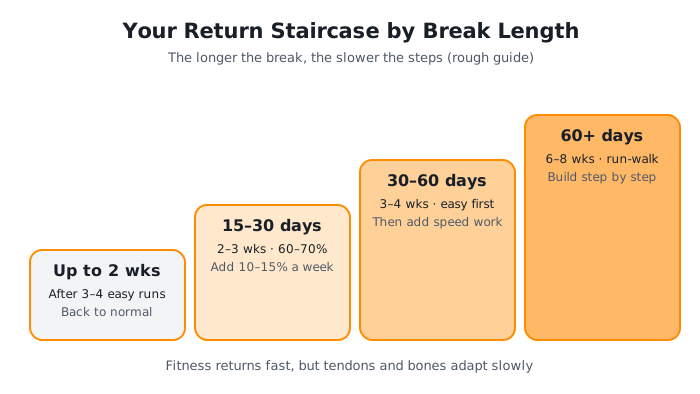
| Time off | How to return | Speed work |
|---|---|---|
| Up to 2 weeks | 3–4 easy runs | After that |
| 15–30 days | 2–3 wks at 60–70% | After week one |
| 30–60 days | 3–4 wks, mostly easy | After an aerobic base |
| 60+ days | 6–8 wks, start run-walk | Very gradually |
Raise your distance by 10–15% a week at most. If you ran 20 km (12.4 mi) a week before a month off, you'd start around 12–14 km (7.5–8.7 mi) the first week. That ratio comes from the guide, so go lower if you need to.
💡 Tip
Not sure where to start? Begin with easy running plus walking. If it finishes comfortably, add a little next week.
3. Your first two weeks back: a sample plan
The goal for these two weeks isn't to run well; it's to rebuild the habit of going out. The NHS Couch to 5K plan has you run three times a week with rest days between, starting week one with 1 minute of running and 1.5 minutes of walking. If you're coming back from a break, borrowing that run-walk idea takes much of the pressure off.

Here's a sample for someone who's been off 15–30 days. It's a starting point, not a rule, so shorten the run intervals if you're out of breath.
- Week 1: 3 days, run 2 minutes and walk 1 minute, six times (about 18 min)
- Week 2: 3 days, run 3 minutes and walk 1 minute, five times (about 20 min)
- Rest days: one day off between runs
- Effort: easy enough to chat with a friend
⚠️ Caution
If you stopped because of an injury or illness, check with a medical professional before restarting. Stop and get checked if you feel chest pain, dizziness, or cold sweats, or if you have pain that makes it hard to put weight on a leg, or swelling and heat. Never run through pain. For injury-prevention basics, see How to Run for the Long Haul Injury-Free: From Preventing Knee Pain to Recovery.
If you'd like more detail on run-walk ratios, read Run-Walk for Beginners: How to Start Running Without Gasping for Air. And if your break was long enough that it feels like starting over, skim the basics in The Complete Beginner's Guide to Running.
4. How to stay consistent without comparing to your old times
The hard part of coming back is often your head, not your legs. The moment you compare today's pace with your old one, "why bother?" creeps in. For the first four weeks, ignore pace and just count how many times you went out.

Slow is fine! Just by showing up, you're already ahead of last week.
In the Wittiz app, set this week's goal as a count, like "run 3 times." Every distance you run earns jelly, and Moongti is happy to see you even after a long gap. Think of it as coaxing a sulky Moongti back with an easy outing.
After a month, your report shows exactly how many times you showed up. To make it stick, try Want to Make Running a Habit? A No-Quit 30-Day Plan for Beginners too.
Frequently Asked Questions (FAQ)
Can I restart running after a month off?
Yes, absolutely. A month off lowers your VO2max somewhat, but starting at 60–70% of your usual distance and building over 2–3 weeks brings most people back smoothly. If you stopped because of an injury or illness, talk to a medical professional first.
How much should I cut my distance when I restart running after a break?
After 15–30 days off, one guideline is to start at about 60–70% of your usual distance and add 10–15% a week. After longer breaks, starting with run-walk and allowing 6–8 weeks is safer. If you feel heavy, go lower.
When can I restart speed work after a break?
After 15–30 days off, add it after an easy first week. After 30+ days, build an easy aerobic base for 3–4 weeks first. Rushing can outpace your tendons and bones.
Wrapping Up
The key to restarting running is coming back at the speed that fits you now, not the you from before.
This week, just go out twice for 20 minutes of run-walk. Moongti will be waiting by the door!
Try it for yourself in the Wittiz app!

References
- Mujika I, Padilla S. (2000). Detraining: Loss of Training-Induced Physiological and Performance Adaptations. Part I: Short Term Insufficient Training Stimulus. Sports Medicine
- RunnersConnect. How Fast Do You Lose Running Fitness? (And How to Get It Back)
- NHS. Get running with Couch to 5K
This article was written by the Wittiz team and includes app-related content. If you're returning after an injury or illness, or have a medical condition, please be sure to consult a medical professional.