
Running Shoe Rotation: What Changes When You Alternate Two Pairs?
💡 Key Summary
✅ Runners who used more than one pair of shoes had about 39% lower injury risk over 22 weeks
✅ It was an observational study, so the shoes themselves can't be named as the cause
✅ Alternate two comfortable pairs by purpose, and keep a separate mileage count for each
"Just wear one pair until it's dead," right? Yet as running becomes a habit, you start noticing runners who swap between two pairs, and you wonder if it actually helps. This guide is for runners curious about running shoe rotation, covering what research shows, where it falls short, and how to set one up.
1. Does running shoe rotation really cut injuries?
The most cited evidence is a 2015 paper by Malisoux and colleagues in the Scandinavian Journal of Medicine and Science in Sports. 264 recreational runners logged their runs and injuries online for 22 weeks. About a third of them, 87 runners, got injured at least once.
The table shows the results. Runners who used two or more pairs in parallel had a hazard ratio of 0.61, meaning about 39% lower risk than runners who used one pair.
| Factor checked | Hazard ratio | How to read it |
|---|---|---|
| Two or more pairs in parallel | 0.61 | Lower risk |
| Previous injury | 1.72 | Higher risk |
| Longer average run | 0.80 | Lower risk |
| More hours of other sports | 0.85 | Lower risk |
Still, this was an observational study, not a randomized trial. RunnersConnect also points out that runners who rotate shoes may simply have been more careful about injuries to begin with. So the accurate reading is not "rotating prevents injury" but "runners who rotated got hurt less."

Correlation isn't causation. Use the numbers as a hint, and let comfort come first!
2. Why might alternating two pairs help?
The researchers suggested that varying your shoes or adding other sports shifts the load on your feet and legs a little, so the same tissues don't take the same stress every run. It's a hypothesis, and this study alone can't tell which factor does the work.
Some common explanations are weaker than others. The table separates them.
| Common claim | Evidence | In one line |
|---|---|---|
| Spreads load, fewer injuries | Hypothesis | One observational study |
| Foam recovers while resting | Weak | No cushion recovery at 24–48 h |
| Shoes last longer | Mixed | Total mileage is the same |
| Better fit per purpose | Anecdotal | Varies by person |
RunnersConnect describes a 1985 study by Cook and colleagues in which shoe cushioning did not recover after 24 or 48 hours of rest. Marathon Handbook, on the other hand, recommends giving each pair 24–48 hours between runs. Since opinions split, "resting the foam to make shoes last" alone isn't a good reason to buy a second pair.
📌 Note
According to RunnersConnect, using two pairs in parallel lasts about as long as using them one after another, though the upfront cost is higher. It cites roughly 400 miles (about 640 km) as one reference point for replacement, but shoes vary, so also check sole wear and how the cushioning feels. For more on choosing shoes, see How to Choose Your First Running Shoes.
3. How do you set up a shoe rotation?
Two pairs are enough to start. Marathon Handbook says any two pairs you can alternate already count as a rotation, and that splitting them by purpose is even better. RunnersConnect suggests that alternating two different models may offer the most benefit.
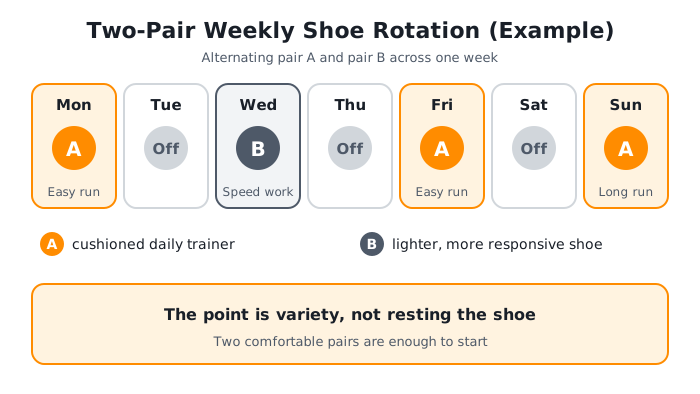
- 2 pairs: Mix a cushioned daily trainer (A) with a lighter, more responsive shoe (B).
- 3 pairs: Split into a daily trainer for easy and long runs, a speed shoe for tempo and intervals, and a race shoe.
- Don't overdo it: Only put shoes you can run comfortably in into the rotation.
- Break in new pairs slowly: Start with short, easy runs.
A simple way to begin is to keep the comfortable pair you already wear and add a second, different model. If you're tempted to add a specialty shoe such as a carbon plate model, read the carbon plate shoes guide first.
⚠️ Caution
If a new pair brings unusual pain in your shins, knees, Achilles or arches, stop wearing it and go back to your old pair. If you can't put weight on the leg, or swelling or heat lingers, please see an orthopedic or sports medicine doctor. The basics are also covered in the running injury prevention guide.
Don't leave mileage per pair to memory. In the Wittiz app, set a goal for how many times you'll run this week and check each day's distance in your records. If you jot A or B in your calendar or notes for each run, adding up mileage per pair is easy, and the jelly you earn with each goal lets you dress up Moongti along the way.

New shoes, fresh mood. Which pair are we running in today?
Frequently Asked Questions (FAQ)
Do I have to rotate running shoes?
No. The research is a single observational result, so it can't prove the shoes were the cause. If one pair feels good, keep going, and add a second pair when you get curious.
How many pairs of running shoes are enough?
The study looked at using two or more pairs in parallel. Most running sites mention two or three, but there's no magic number. Considering cost and storage, keep only as many as you can run in comfortably.
Is it bad to wear the same running shoes every day?
There's no firm evidence that it is. Still, since parallel use was seen in runners with lower injury risk, alternating is worth trying if your usual pair starts to feel off. If pain continues, rest from running and see a doctor.
Wrapping Up
Shoe rotation is less a rule than one more option for finding what fits your feet.
This week, add a comfortable second pair to the one you wear now and alternate at least once. Jot down A or B for each run, and Moongti will be running right beside you!
Try it for yourself in the Wittiz app!

References
- Malisoux L, Ramesh J, Mann R, Seil R, Urhausen A, Theisen D. (2015). Can parallel use of different running shoes decrease running-related injury risk? Scandinavian Journal of Medicine and Science in Sports
- RunnersConnect. Does Rotating Your Shoes Reduce Your Risk of Running Injuries?
- Marathon Handbook. Running Shoe Rotation
This article was written by the Wittiz team and includes app-related content. If you have foot, knee or shin pain or a history of injury, please don't push through it and be sure to consult a medical professional.