
Running Slump: 5 Things to Change When Running Gets Boring
💡 Key Summary
✅ A running slump often shows up when the route, pace, and pressure to improve all stay the same
✅ Changing just one thing at a time (route, time, company, goal, or music) is enough
✅ If fatigue won't lift or something hurts, it may be a sign to rest, not a slump
"Why has running gotten so boring lately?" You've probably thought it at least once. Your shoes are by the door, but your body just won't follow. This guide is for runners stuck in a running slump: why it happens, what to change, and how to tell when rest is the better answer.
1. Why Does a Running Slump Happen?
A slump isn't a sign of weak willpower. The coaching site RunnersConnect lists common reasons motivation dips: a goal you've already reached, built-up fatigue, repetitive training, the letdown after a race, big life changes, and comparing every run with your past self. Spotting which one fits you makes the fix easier.
| Cause | What it feels like | Try first |
|---|---|---|
| Same route again | Nothing catches your eye | Change the route |
| Pace pressure | Pace feels like homework | Run without a watch |
| After a goal | What am I running for? | Pick a new goal |
| Built-up fatigue | Body feels heavy | A lighter week |

Feeling bored isn't bad news. It's a hint that your routine is getting stale!
An opinion paper in the journal Frontiers in Psychology (2020) explains that repeating the same exercise can lead to boredom, and boredom can lower motivation, a cycle that new activities might break. That's a hypothesis, and the authors themselves note there's little research on it. So treat it as "worth trying," not a guarantee.
2. Beat the Running Slump: Change One of These 5 Things
Changing everything at once feels like a chore. Pick just one to change this week. Runner's World suggests small shifts like a new route, running with a friend, leaving the watch at home, or switching up your music or podcast.
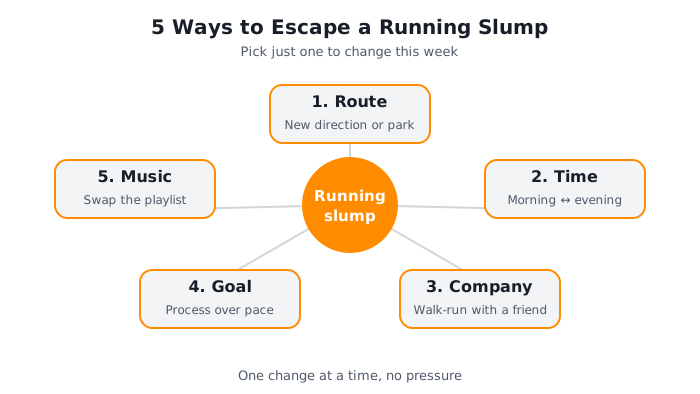
- Route: Run your usual loop in reverse, or try a park or river path you haven't visited
- Time: If you're a morning runner, try an evening run, or catch a sunrise once
- Company: Walk-run with a friend or family member so conversation covers the boredom
- Goal: Swap pace goals for process goals like "explore 3 new paths"
- Music: A new playlist or podcast can make the same road feel different

If running alone has lost its spark, check out A Guide to Joining a Running Crew for a low-pressure start. The UK's NHS Couch to 5K page also notes that running with a friend or group can make it more enjoyable.
💡 Tip
Keep the volume low enough to hear your surroundings. Try new routes in daylight, on paths where other people are around.
3. Slump or Signal to Rest?
Boredom and overtraining can look alike. Runner's World says that if the signs below stick around, rest may come before any change of routine. If one or two show up for a few days, take it easy. If they linger, talk to a professional.
| Sign | What it may mean | Next step |
|---|---|---|
| You quietly avoid running | Closer to a slump | Change one of the 5 |
| Fatigue despite good sleep | Not enough recovery | Rest, lower intensity |
| Frequent irritability or apathy | Possible overload | Take 1–2 weeks off |
| Same spot keeps hurting | Possible injury | See a doctor |

The same guide points out that if you feel guilty the whole time you're resting, it's avoidance, not recovery. So give your break a small anchor, like "two walks this week." For tips on coming back, see Restarting Running After a Break.
⚠️ Caution
If you feel chest pain, dizziness, or a cold sweat while running, or have pain that makes it hard to put weight on a leg, swelling, or heat, stop right away and see a doctor. It may be your body talking, not your mood.
4. A Tiny Rule for Days You Don't Feel Like It
In a slump, "just get out the door" beats "run well." On low-motivation days, tell yourself just 10 minutes. RunnersConnect gives similar advice: promise a short distance and forget pace. Many days, once you've started, you'll want to keep going.

Ten minutes out the door still counts. If you want more, that's a bonus!
Wittiz is a more fun and smarter running app, which makes it handy for shaking up a dull week. Set a small mission like "2 new routes" or "3 runs this week," and spend the jelly you earn dressing up Moongti. Think of it as going out to cheer up a sulky Moongti, and the front door gets a little lighter. To turn it into a month-long habit, see the 30-Day Running Habit Challenge.
Frequently Asked Questions (FAQ)
How long does a running slump last?
There's no set length. Some people feel better within a week or two of changing their route or running partner. If fatigue is the cause, 1–2 weeks of rest may help, and if it lasts over a month, try setting a fresh goal.
Should I rest or keep running when running gets boring?
If your body feels heavy or you're irritable and unmotivated, rest lightly first. If your body is fine and only your mind is bored, change the route, company, or music instead. Walking during a break is fine.
How do I get out the door when I have no motivation?
Make a tiny promise like "just 10 minutes." Don't worry about pace or distance. Once you're out the door, you're halfway there.
Wrapping Up
A running slump isn't the end. It's a signal that it's time to change how you run.
This week, change just one thing, whether it's the route or the music, and head out once. Moongti will be waiting for you on the new path!
Try it for yourself in the Wittiz app!

References
- Lakicevic N, et al. (2020). Make Fitness Fun: Could Novelty Be the Key Determinant for Physical Activity Adherence? Frontiers in Psychology
- Runner's World. The Runner's World Guide to Getting Out of a Training Slump
- RunnersConnect. You Haven't Lost Your Love of Running — You've Lost Your Why
- NHS. Get running with Couch to 5K
This article was written by the Wittiz team and includes app-related content. If you have pain or an underlying health condition, please don't push yourself and be sure to consult a medical professional.