
Coffee Before Running: Does Caffeine Help? Dose, Timing and Cautions
💡 Key Summary
✅ Caffeine is one of the few supplements with fairly consistent benefits for endurance exercise
✅ Aim for 3–6 mg per kg of body weight, finished 45–60 minutes before you start, low end first
✅ If your stomach or sleep complains, cut the dose or skip the afternoon cup
"A cup of coffee before your run makes you faster" — you've probably heard that one. But maybe you tried it and ended up queasy, or hunting for a bathroom at kilometer two. This guide is for beginner runners and diet-minded runners who wonder whether coffee before running is worth it, with the evidence, the dose, the timing and the cautions.
1. Does coffee before running really help?
The short answer: caffeine is likely to help, especially over longer efforts. The International Society of Sports Nutrition (ISSN) says 3–6 mg of caffeine per kg of body weight has consistently improved exercise performance, with the most reliable gains in aerobic endurance.

It doesn't work the same for everyone, though. The position stand describes cases where, at the same dose, people who clear caffeine quickly got faster while slow metabolizers actually got slower. So your own response matters more than what works for a friend.
| Question | What the research says | Short version |
|---|---|---|
| Does it help? | Most consistent in endurance | Likely, yes |
| Must it be coffee? | Coffee and pills were similar | Decaf didn't work |
| Does daily coffee blunt it? | Not in one cycling trial | Keep your routine |
In a cycling study, coffee, pure caffeine and pills improved time-trial results by a similar amount, while decaf did nothing. And in one trial, regular coffee drinkers still got the race-day boost, so you don't need to quit coffee to prepare. For the bigger picture on meals, see Running Meal Timing.

Coffee isn't magic. Think of it as a helper that might work for you!
2. How much coffee before a run, and when?
The ISSN treats 3–6 mg per kg as the effective range. The minimum effective dose isn't firmly set and may be as low as 2 mg/kg, while very high doses like 9 mg/kg add side effects without extra benefit. So start at the low end.
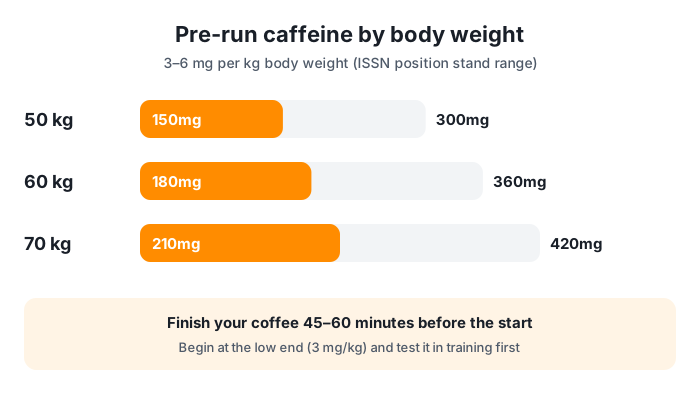
| Weight | 3 mg/kg (start) | 6 mg/kg (upper end) |
|---|---|---|
| 50 kg (110 lb) | 150 mg | 300 mg |
| 60 kg (132 lb) | 180 mg | 360 mg |
| 70 kg (154 lb) | 210 mg | 420 mg |
These are simple calculations from the position stand's range, not a prescription. RunnersConnect says a 150 lb (68 kg) runner needs about 200 mg, roughly one 12 oz cup of coffee. But caffeine per cup varies by bean and brew, so check the label when you buy a cup out.
The most common timing is about 60 minutes before you start. RunnersConnect suggests finishing 45–60 minutes ahead, for example sipping between 6:00 and 6:15 a.m. for a 7:00 start, with a bathroom stop before warm-up. If you'd rather top up with gels on long runs, see When to Take Energy Gels.
💡 Tip
One cup is plenty before a run. Sugary lattes carry more calories than you'd think, so if you're watching your weight, black coffee or just a splash of milk keeps it light.
3. Stomach, sleep and jitters: what to watch for
Caffeine isn't all upside. The ISSN lists disrupted sleep and more anxiety as typical side effects, noting that it can lengthen the time to fall asleep and reduce deep sleep. The CDC also suggests avoiding caffeine in the afternoon and evening to protect your sleep.

Stomach trouble is the most common complaint among runners. According to RunnersConnect, caffeinated coffee stimulates the colon, so plan a bathroom stop before you head out.
- If your stomach acts up mid-run, try a different form such as caffeine gum instead of coffee.
- If an empty stomach burns, have something light like half a banana with it.
- If your heart races or your hands shake, cut the dose in half.
- For an evening run, drink it earlier or skip it that day.
⚠️ Caution
If you have heart disease or an arrhythmia, high blood pressure, an anxiety disorder or insomnia, or you're pregnant, talk to your doctor before using caffeine for exercise. Stop and get help if you feel chest pain, a severe pounding heartbeat, dizziness or a cold sweat while running. High-dose caffeine products carry an overdose risk, so we don't recommend them.
4. Test it on your own body, one week at a time
RunnersConnect also advises against trying it for the first time on race day; test the dose and timing in training. Some studies even found slower times on caffeine, so a week-by-week comparison is the most reliable way to know.
| Week | What to try | What to note |
|---|---|---|
| Week 1 | Run without coffee as usual | Pace, stomach |
| Week 2 | One coffee an hour before | Pace, stomach |
| Week 3 | Stick with what felt better | Sleep, energy |
In the Wittiz app, set a goal like "run 3 times this week." Go without coffee one week and with coffee the next, then compare pace and distance in your report. You can spend the jelly you earn dressing up Moongti along the way.

Let's find out together which days felt better, with coffee or without!
Frequently Asked Questions (FAQ)
Is it OK to drink coffee before running?
For most healthy adults, yes. Start low at around 3 mg per kg, finish 45–60 minutes before the start, and watch how your body responds.
Can I run on coffee with an empty stomach?
If your stomach is fine, you can, but some people get heartburn or nausea. Try half a banana alongside it or a smaller dose. For fasted running in general, see the Running Diet Guide.
Does coffee dehydrate you?
RunnersConnect says moderate coffee hydrates about as well as water, so you don't need extra water to offset it. On sweaty days, keep up your normal fluids as usual.
Wrapping up
Coffee before running works best as a low dose of about 3 mg per kg, finished 45–60 minutes before you start, adjusted to how your body responds. Comfort comes before any possible boost.
This week, add one cup on a single run day and jot down how your stomach and pace felt. Moongti will be right beside you, enjoying the road more than the coffee!
Try it for yourself in the Wittiz app!

References
- International Society of Sports Nutrition (2021). Position stand: caffeine and exercise performance. Journal of the International Society of Sports Nutrition
- RunnersConnect. Coffee Before Running: How Much, When, and Is It Worth It?
- CDC. About Sleep
This article was written by the Wittiz team and includes app-related content. If you have a heart condition, high blood pressure or an anxiety disorder, are pregnant, or feel unwell while exercising, please be sure to consult a medical professional.