
Marathon Packing List: Race-Day Checklist from Bib to Bag Drop
💡 Key Summary
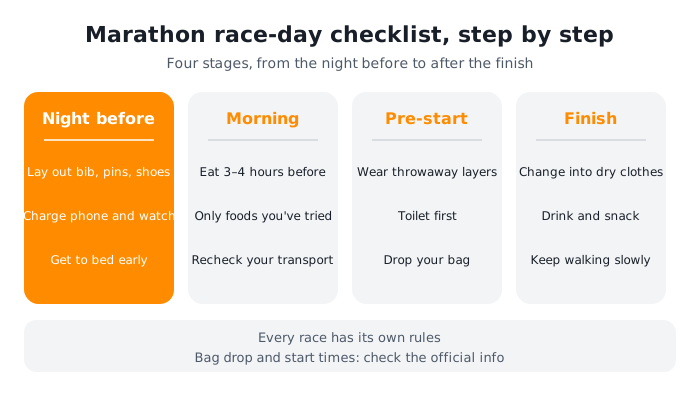
✅ Split your marathon packing list into four stages: night before, morning, start line, and finish
✅ On race day, only bring shoes, clothes, and snacks you've already used in training
✅ Bag drop rules and start times differ by race, so check the official info
"I got home the night before and realized I had no safety pins." First-time racers say this all the time. But the packing lists online are so long it's hard to tell what really matters. This post is a marathon packing list for first-time racers, in order, from the night before to after the finish.
1. The Night Before: Lay Out Your Marathon Gear
The running store Fleet Feet suggests packing two or three days ahead, so the night before is just a final check. The big rule is simple: nothing new on race day.
The table below is a trimmed list based on two guides. Add or remove items depending on distance and weather.
| Category | What to pack | Note |
|---|---|---|
| Wear | Tested shoes, socks, kit | Nothing brand new |
| Race items | Bib, pins, ID, entry proof | Save a screenshot too |
| Fuel | Gels, snacks, bottle | Only what you've tried |
| Care | Sunscreen, anti-chafe, plasters | Watch underarms, thighs |

Lay it all out and snap a photo. In the morning you'll see at a glance if anything's missing!
2. What Should You Eat in the Morning, and When Should You Leave?
Nuffield Health, a UK health provider, cites research suggesting a full meal about 3–4 hours before the start, or a light snack 1–2 hours before. For a first marathon, it suggests waking 2–3 hours before the gun. Something you've eaten before, like peanut butter on toast or a banana, is the safe pick.
There's no single right meal. A joint position paper from the Academy of Nutrition and Dietetics, Dietitians of Canada, and the American College of Sports Medicine says nutrition plans should be individualized, ideally with a sports dietitian. So the best rehearsal is trying your breakfast on a long-run morning.
💡 Tip
Toilet lines get long at big races. Plan to reach the start area an hour early and visit the toilets first.
3. At the Start and After the Finish: Throwaway Layers and Bag Drop
Waiting at the start can take longer, and feel colder, than you'd expect. Fleet Feet suggests bringing things you can throw away: old warm clothes, old sneakers, a small blanket or trash bag. Large races often collect discarded clothing for donation.
Nuffield Health also suggests arriving at the start area at least an hour before your wave. Plan your parking or transport and have a backup, since road closures can slow big races down.
After the finish, your sweat cools fast and you get cold quickly. So put only post-race items in your drop bag. Size limits and drop-off times vary by race.
- Dry top, pants, and socks, plus a warm layer
- Towel and sandals
- A drink and an easy snack
- Wallet, keys, and a spare charger
For race-week training and tapering, see One Week Before a Marathon: JTBC Marathon D-7 Checklist. For fueling, try When Should You Take Energy Gels?, and for the meal before, How to Carb-Load for a Marathon.
Before the start, a familiar routine beats anything new. Easy and steady, let's go!
4. Every Race Differs: What to Confirm on the Official Site
Bag drop location and cut-off, start time, wave, and bib pickup differ by race. This post doesn't list any specific race's details. On the official website of the race you've entered, fill in the table below.
| What to check | Official info | If you miss it |
|---|---|---|
| Start time, wave | Check the official website | No start if late |
| Bag drop cut-off | Check the official website | Bag can't be left |
| Bib pickup | Check the official website | No start |
⚠️ Caution
If you feel chest pain, severe dizziness, a cold sweat, or sudden breathlessness while running, stop right away and tell race staff or medical personnel. If you have heart disease or another condition, talk to your doctor before the race.
A checklist you only read is easy to forget. In the Wittiz app, add pre-race missions like "check gear this week" or "pack the bag the night before," one small step a day. Cheering each other on with a friend running the same race makes it less nerve-racking, and the jelly you earn dresses up Moongti.
Frequently Asked Questions (FAQ)
What is the most important item on a marathon packing list?
Your bib, ID, and the shoes and clothes you've already worn in training. Save anything new for after the race.
What should I do the night before a marathon?
Pack ahead and just double-check. Nuffield Health suggests a dinner with carbs and protein, going easy on alcohol and caffeine, and getting to bed early.
What goes in a marathon bag drop?
Dry clothes to change into, a towel, sandals, and an easy snack. Size limits and cut-off times differ, so check the official info.
Wrapping Up
Pack your marathon gear in four stages (night before, morning, start line, and finish) and you'll have it covered. Bring nothing new, and check each race's own rules on the official site.
This week, write your list with the gear you already own. Moongti will double-check your bag at the start line with you!
Try it for yourself in the Wittiz app!

References
- Nuffield Health. What to expect the day of your first marathon
- Fleet Feet Montclair. Marathon Check List
- Thomas DT, Erdman KA, Burke LM (2016). Position of the Academy of Nutrition and Dietetics, Dietitians of Canada, and the American College of Sports Medicine: Nutrition and Athletic Performance. Journal of the Academy of Nutrition and Dietetics
This article was written by the Wittiz team and includes app-related content. Race details differ by event and can change. If you have a medical condition or feel unwell while exercising, please be sure to consult a medical professional.