
Running 10 Minutes a Day: Do Short Runs Really Count?
💡 Key Summary
✅ In a large observational study, people who ran under 51 minutes a week still had lower mortality risk than non-runners
✅ Ten minutes, five days a week, adds up to 50 minutes, and that is a solid starting point for a habit
✅ Ten minutes is a start, not a ceiling. Add time when it feels easy, or keep it just as it is
"A real workout is 30 minutes at least, so what could 10 minutes possibly do?" Have you ever thought that? The trouble is that skipping runs because you lack time makes the habit fade fast. This guide is for beginners and busy people wondering whether running 10 minutes a day is worth it, with the research and a realistic routine.
1. What Does Research Say About Running 10 Minutes a Day?
The most-cited study was published in the Journal of the American College of Cardiology (JACC) in 2014. Researchers followed 55,137 adults aged 18 to 100 for about 15 years and compared leisure-time runners with non-runners. According to the American College of Cardiology's press release, runners had about 30% lower risk of death from any cause and about 45% lower risk of death from heart disease or stroke.

What stands out is how little they ran. People who ran under 51 minutes a week, or only once or twice a week, still had lower mortality than non-runners. The same release says those running under an hour a week got about the same benefit as those running more than three hours.
| What was compared | Result | What it means |
|---|---|---|
| Runners vs. non-runners | About 30% lower all-cause risk | Linked to running |
| Under 51 min a week | Risk still lower | A little still counts |
| Under 1 hr vs. 3+ hrs | Similar benefit | Weak case for "more is better" |
A 2019 meta-analysis in the British Journal of Sports Medicine points the same way. According to Science News, it pooled 14 studies and 232,149 people, found 27% lower all-cause mortality for runners, and saw no clear trend by how much they ran. Even the lowest group, running once a week or less for under 50 minutes, showed a benefit.

One thing to remember: these are links, not proof. Nobody said running alone caused it!
2. How Much Do 10 Minutes a Day Add Up To?
The study did not test "10 minutes a day" as its own group. In the ACC release, the lead researcher compared the under-51-minute range to running 5 to 10 minutes a day. So the safe way to read it is: 10 minutes can put you in the same range as those studies, nothing more.
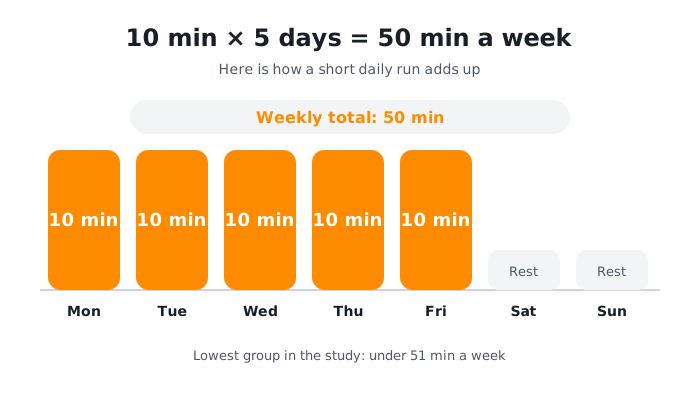
Ten minutes on five days is 50 minutes. The World Health Organization (WHO) suggests at least 150 minutes of moderate activity a week for adults, so 10-minute runs alone will not reach that. Still, WHO says any amount of activity is better than none.
💡 Tip
If 10 minutes feels too small, that's okay. In your first month, the goal is simply to stack up days when you did it.
- Low barrier: even with changing and a shower, it fits within 30 minutes
- Fewer excuses: even on rainy or late-work days, you can find 10 minutes
- Easier tomorrow: you don't burn out, so heading out again is simple
3. Why Ten Minutes Becomes a Habit
A habit forms through how often you repeat it, not how long each session is. In a study summarized by the British Psychological Society, 82 participants repeated a new behavior daily for 84 days, and it took 66 days on average to become automatic. It ranged from 18 to 254 days by person, and missing one day made little difference.
That's why a tiny goal works well at the start. With 10 minutes, the "I'm too tired today" excuse gets weaker. Once repetitions pile up, adding time later is much easier.

A 10-minute day is still a running day. Count the days you did it, not the ones you missed!
4. A 10-Minute Daily Running Routine to Start With
For the first two weeks, fix the time and place, and keep the pace at "I can still talk." If 10 straight minutes is tough, mix in walking. Our Interval Running for Beginners guide covers how to blend walking and running.

| Week | Goal | How |
|---|---|---|
| 1 | 10 min, 3 days | Walking mixed in is fine |
| 2 | 10 min, 4 days | Fix time and place |
| 3 | 10 min, 5 days | Walk only on rest days |
| 4 | 10–15 min, 3–4 days | Stay at 10 if tough |
Pick the time you're least likely to skip: morning, lunch, or after work. For evenings, see Evening Running Routine, and for the science of habits, try the 30-Day Running Habit Challenge.
⚠️ Caution
If you feel chest pain, dizziness, a cold sweat, or unusual shortness of breath, stop right away and rest. If you have heart disease or high blood pressure, or you've been inactive for a long time, check with a doctor first. Don't push through lasting knee or foot pain.
In the Wittiz app, set a goal like "run 5 times a week" and log the 10-minute days too. Even short runs earn jelly by distance and help Moongti grow. Cheering each other on with friends makes it easier to get out the door on lazy days.

Just 10 minutes today! Once you step outside, you're halfway there.
Frequently Asked Questions (FAQ)
Is running just 10 minutes a day effective?
In a large observational study, people who ran under 51 minutes a week still had lower mortality than non-runners. But the study did not prove that running was the cause. Changes in fitness or weight vary by person, so give it several weeks of consistency.
Do I have to run 10 minutes without stopping?
No. Mixing walking and running is fine at first. What matters is that you moved for 10 minutes, and your running time grows naturally as it gets easier.
How long should I stay at 10 minutes?
There's no set time. Once the habit settles in after about four weeks, you can slowly go to 15 or 20 minutes, or drop back to 10 on busy weeks. What counts is not breaking the chain.
Wrapping Up
Running 10 minutes a day isn't a question of "is it enough?" but "can I keep it up?" The research says even a small amount counts, and habits are built by repetition.
This week, pick just three days and run 10 minutes each. Moongti will run those 10 minutes right beside you!
Try it for yourself in the Wittiz app!

References
- American College of Cardiology (ACC). Running Reduces Risk of Death Regardless of Duration, Speed (Lee DC et al., JACC 2014)
- Science News. Running just once a week may help you outpace an early death (Pedišić Ž et al., BJSM 2019)
- British Psychological Society Research Digest. How long does it take to form a habit?
- World Health Organization (WHO). Physical activity fact sheet
This article was written by the Wittiz team and includes app-related content. If you have heart disease, high blood pressure, or other conditions, or feel pain or dizziness while running, please be sure to consult a medical professional.