
Treadmill Running: The 1% Incline and 3 Easy 30-Minute Routines
💡 Key Summary
✅ A flat treadmill is a bit easier than outdoors, so 1% incline is the usual setting
✅ For 30 minutes, just pick one: an easy run, hill intervals, or speed changes
✅ Split the time if you get bored, and run outside now and then to keep your feel
"Can I just run on a treadmill when it's freezing out?" You've probably asked that at some point. But once you step on, it's hard to know what speed or incline to pick, and how to get through 30 minutes. This guide is for runners who want to start treadmill running because of cold or bad air, with the settings and routines laid out simply.
1. How is treadmill running different from running outside?
A 2019 review in Sports Medicine pooled 33 crossover studies (494 participants) comparing treadmill and overground running. Most movement measures turned out to be similar. The exception was foot angle at landing, which was about 9.8 degrees lower on the treadmill. In plain words, you tend to land a little flatter, and the evidence for that was rated low.
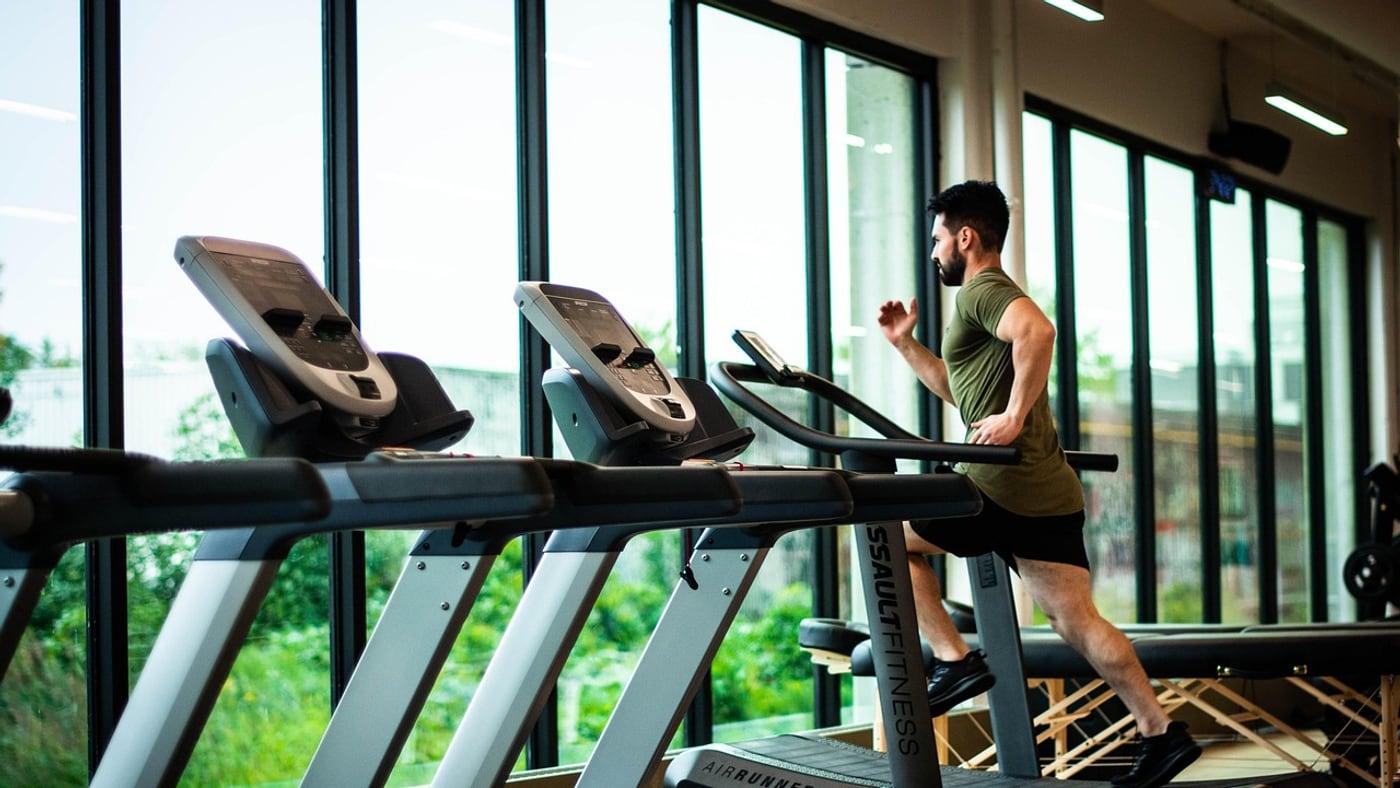
You'll feel a difference too. The belt moves backward for you and there's no wind resistance, so the same speed costs less energy than outside. If you trust the number on the display alone, you may feel faster than you really are.
| Compare | Treadmill | Outdoors |
|---|---|---|
| Wind resistance | Almost none | Yes |
| Speed control | Belt keeps pace | Up to you |
| Weather | No effect | Big effect |
| Surface | Steady and cushioned | Always changing |

The same pace can feel a bit easier indoors. Don't lean too hard on the numbers!
2. Is a 1% treadmill incline enough?
The standard for treadmill incline comes from a 1996 study by Jones and Doust. Nine trained male runners ran 6-minute efforts at six speeds while their oxygen use was measured, and 1% incline matched the energy cost of level outdoor running best. The explanation is that a flat treadmill has no air resistance, which makes it look cheaper than it is.
The result has limits. The speeds tested were roughly 10.5–18 km/h, and each machine has its own belt friction and incline calibration, so it may not match exactly on yours. The researchers suggested about 0.5% for slower paces and 2% for faster ones, but those are extrapolations, not tested values.
- Start with 1% for easy runs
- If your machine can't do half steps, pick flat (0%) or 1%, whichever feels better
- Check the talk test too (you can say short sentences), not just the speed
💡 Tip
A 1% incline matches outdoor energy cost. It isn't there to make the run harder. If you want more incline, treat it as a hill workout and set aside a specific block for it.
3. Three non-boring 30-minute treadmill routines
Runner's World Australia shares three beginner treadmill workouts: a base run, hills, and speed changes. The chart below is the Wittiz team's 30-minute version based on that idea. It isn't a research-tested plan, so shorten it if you need to.
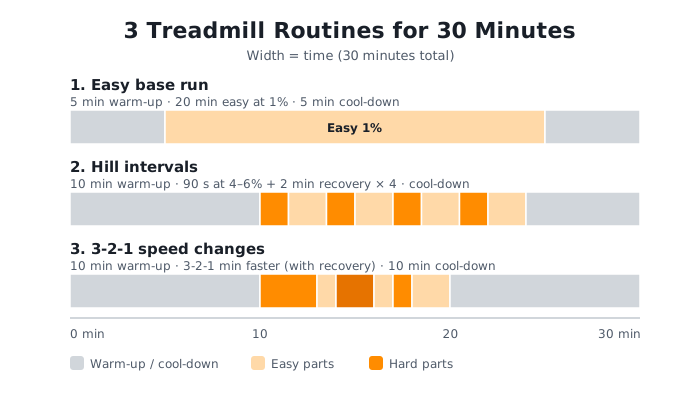
| Routine | Setup | Good for |
|---|---|---|
| Easy base run | 20 min easy at 1% | Your first day |
| Hill intervals | 90 s at 4–6% × 4 | Building leg strength |
| 3-2-1 speed changes | 3, 2, 1 min, faster each time | When boredom hits |
In the Runner's World Australia version, hill intervals mean 90 seconds at 4–6% at a medium-hard effort, then 2 minutes of walking or easy jogging at a lower incline. You repeat 4 to 10 times depending on fitness, so start with 4 reps and a lower incline. For speed changes, run 3 minutes and rest 1, run 2 minutes faster and rest 1, then run 1 minute fastest and rest 2.

Even just the easy run is plenty today. Finishing it is what counts!
If you're new, get comfortable with the easy run first, then swap in hills or speed changes once a week. Not sure what "easy" feels like? See Easy Run Pace Guide: How Slow to Run and the 80/20 Rule. To add a comfortably hard block, try How to Do a Tempo Run: 20 Minutes at a Comfortably Hard Pace.
4. Using the treadmill safely and consistently
The longer you run on a treadmill, the more boredom and habit build up. RunnersConnect suggests keeping long treadmill blocks to about 90 minutes and doing one hard session outdoors every 2–3 weeks to calibrate your pacing. Treat that as one outlet's practical tip, not a rule.
- Check the safety clip and emergency stop button before you start
- Don't hold the rails, and keep your eyes forward
- Raise the belt speed gradually, and lower it gradually at the end
- Keep a water bottle and towel within reach
- Log distance and time so you can compare with your outdoor runs
⚠️ Caution
If you have heart disease or high blood pressure, have been off exercise for a long time, or have knee or ankle pain, talk to a healthcare professional before raising the intensity. If you feel chest pain, dizziness, or a cold sweat while running, slow down gradually, stop, and get checked. Pain that makes it hard to put weight on a leg, or swelling and heat, is also a reason to take a break.
Indoor runs count when they're logged, and your weekly rhythm stays unbroken. In the Wittiz app, set a goal like "run 3 times this week," then check your treadmill runs alongside outdoor ones in the report on bad-weather days. Every goal you hit earns jelly to dress up Moongti, whether you ran inside or out.

You came out even in the rain? Nice! Every run you did counts.
New to all this? See The Complete Beginner's Guide to Running for the big picture, and How to Use a Running App Smartly: A Complete Guide to GPS, Pace, and Heart Rate for reading your numbers.
Frequently Asked Questions (FAQ)
Is treadmill running as effective as running outside?
Most movement measures look similar. But there's no wind resistance and you land a bit differently, so keep a 1% incline and mix in some outdoor runs.
What incline should I set on the treadmill?
For easy running, 1% is the usual setting. Anything higher becomes hill training, so use 4–6% in short blocks. Machines differ, so double-check by how it feels.
Thirty minutes on a treadmill is so boring. What can I do?
Break it up. After a 10-minute warm-up, add hill intervals or 3-2-1 speed changes and the time flies. Music or videos are fine, as long as your eyes don't drift far from the belt.
Wrap-Up
Start treadmill running at 1% incline, and sticking with one 30-minute routine is plenty. It's a great bad-weather backup, but keep your outdoor feel alive too.
This week, try one 20-minute easy run on the treadmill. Moongti will be jogging on the next belt over!
Try it for yourself in the Wittiz app!

References
- Van Hooren B, Fuller JT, et al. (2020). Is Motorized Treadmill Running Biomechanically Comparable to Overground Running? A Systematic Review and Meta-Analysis of Cross-Over Studies. Sports Medicine
- RunnersConnect. 1% Treadmill Incline: What the Research Actually Says
- Runner's World Australia. 3 Beginner Treadmill Workouts to Build a Base, Tackle Hills, and Work on Speed
This article was written by the Wittiz team and includes app-related content. If you have pain or a medical condition, or feel unwell while running, please be sure to consult a medical professional.