
How to Do a Tempo Run: 20 Minutes at a Comfortably Hard Pace
💡 Key Summary
✅ A tempo run is a steady effort that feels comfortably hard, not easy and not all-out
✅ Set the pace by feel: you can only manage short phrases, not full sentences
✅ Start with 10–20 minutes once a week, and split it up if you can't hold it
"Everyone says tempo runs help, but how fast am I supposed to go?" Sound familiar? Easy runs feel too gentle and intervals feel too tough, so the middle ground is easy to get wrong. This guide is for runners trying their first tempo run, covering the idea, how to find your pace, and a simple 20-minute start.
1. What Is a Tempo Run? Lactate Threshold in Plain Words
Nike describes a tempo run as a sustained effort just below your lactate threshold. Think of that threshold as the point where running stops feeling sustainable. Tempo runs nudge that point higher, so the same speed gradually feels less hard.

Research points the same way. A 2009 review by Faude and colleagues looked at 32 studies linking lactate threshold to endurance performance, and most found strong correlations, especially in running. That's an association, though, not proof that tempo runs themselves raise your race times.
| Type | Easy run | Tempo run | Intervals |
|---|---|---|---|
| Feel | Relaxed | Comfortably hard | Very hard |
| Length | Long | 10–40 min steady | Short reps |
| Purpose | Aerobic base | Sustained effort | Speed |

A tempo run isn't about going fast. It's about holding on a little longer!
2. Find Your Tempo Pace With the Talk Test
Nike rates tempo effort at about 7 out of 10. Full sentences should feel hard, but you shouldn't be gasping. If you're breathless in the first few minutes, you're going too fast.
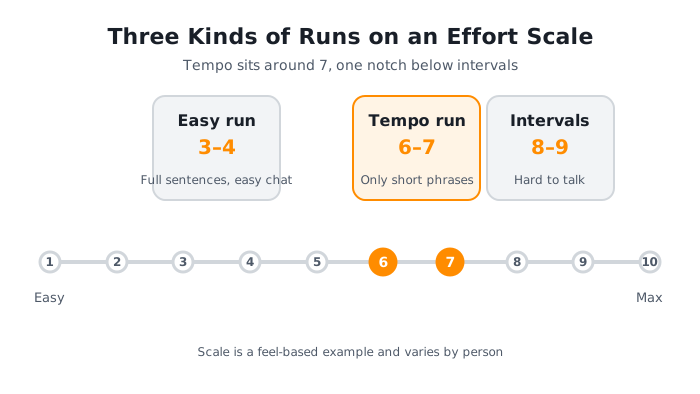
Heart rate guidance varies by source. Nike mentions 75–85% of max heart rate, while Haugen and colleagues (2021), writing about elite middle-distance runners, use roughly 83–87%. Because individuals differ so much, start with feel instead of numbers.
- You can say two or three words at a time
- Holding a long conversation is hard
- You could keep the same pace for the last five minutes
For reading your metrics, see Running App Guide: Understanding Pace, Heart Rate and Cadence. For easy effort, see Easy Run Pace Guide: How Slow to Run and the 80/20 Rule.
💡 Tip
It's fine if your watch pace is slower than your goal. Heat, hills, and wind slow the numbers even when the effort is the same.
3. Start With 20 Minutes or Cruise Intervals
Nike suggests 10 to 20 minutes for beginners. If holding it for that long is too much, you can break it into pieces with short rests. One beginner example is 5 easy minutes, then 3 minutes at tempo twice, then a cooldown.
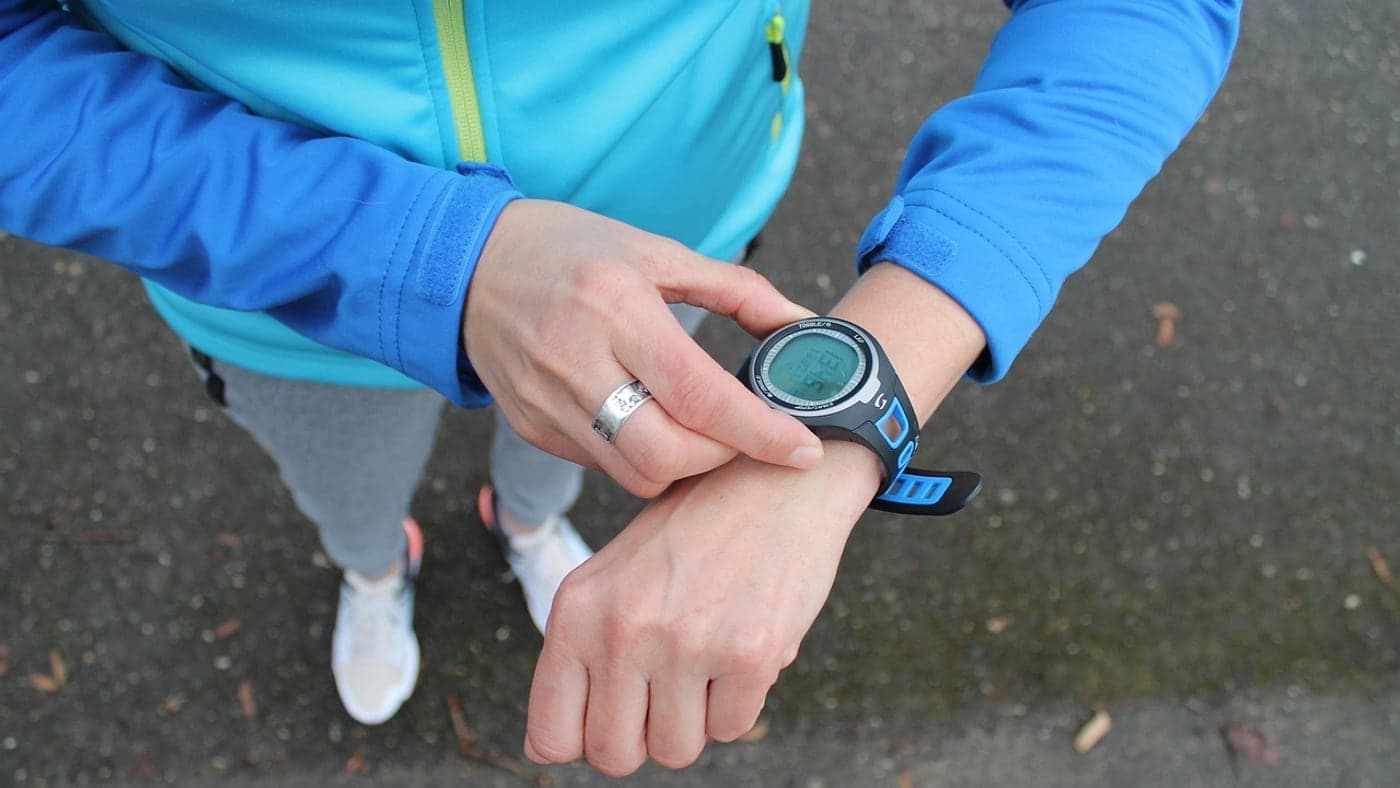
Splitting a tempo effort into chunks with short breaks is often called cruise intervals. Haugen and colleagues (2021) cite sessions such as 2–4 reps of 10 minutes with 2–3 minutes of recovery for elite athletes. Everyday runners should start much shorter than that.
| Level | Session | Good for |
|---|---|---|
| Starter | 5 min easy → 3 min tempo × 2 → cooldown | First tempo run |
| Basic | 10 min easy → 20 min tempo → cooldown | 5K runners |
| Split | 5 min tempo × 3, 1–2 min walk or jog between | Can't hold it steady |
The table is an example the Wittiz team built from these sources, not a research-validated plan. Always warm up with at least 10 minutes of easy running first.

Even three minutes is a big win. Add just one more minute next week!
4. How Often, and Where Does It Fit?
Nike suggests once a week for newer runners and two or three for experienced ones, with no back-to-back tempo days. Haugen and colleagues (2021) summarize that endurance athletes do about 80% of sessions at low intensity and around 20% at threshold or above. So tempo runs work best as a seasoning in a week built on easy running.
| Example day | Workout |
|---|---|
| Mon · Wed · Fri | Easy run |
| Thu | Tempo run (or intervals) |
| Sun | Long run |
If you want intervals in the same week, see Interval Running for Beginners. For a 10K goal, try the 10K 8-Week Training Plan, and for long runs, read the LSD Long Run Guide.
⚠️ Caution
If you have heart disease or high blood pressure, have been inactive for a long time, or have any pain, talk to a medical professional before raising your intensity. Stop right away and get checked if you feel chest pain, dizziness, cold sweats, or unusual breathlessness. The same goes for swelling or pain that keeps you from putting weight on a knee or ankle.
A tempo run matters less as a single result than as a pattern over several weeks. In the Wittiz app, set a weekly goal like "include one tempo block this week" and check your records to see if your split paces stayed steady. The jelly you earn from missions dresses up Moongti, which makes a good small reason to head out on a hard day.

If you're gasping, ease off one notch. The right pace is one you can hold to the end!
Frequently Asked Questions (FAQ)
How often should I do a tempo run?
Once a week is plenty for beginners. As you get comfortable you can go up to twice, but avoid back-to-back days and fill the rest with easy runs. If you feel run down, it's fine to skip a tempo day.
How do I set my tempo pace?
The easiest way is the talk test. Find an effort where you can only say short phrases, and pick a speed you could hold until the end. Heart rate and race-time methods vary by source, and individual differences are big.
What if a tempo run feels too hard?
Ease off one notch or split it into pieces. Three 5-minute blocks with 1–2 minutes of slow jogging between them are much easier. If fatigue lingers for several days, go back to mostly easy runs.
Wrapping Up
A tempo run is a comfortably hard effort you build up slowly, in short blocks first. Set the pace by feel, not numbers, and 10–20 minutes once a week is enough to start.
This week, try two 3-minute tempo blocks inside an easy run. Moongti will be right beside you, catching its breath too!
Try it for yourself in the Wittiz app!

References
- Faude O, Kindermann W, Meyer T. (2009). Lactate threshold concepts: how valid are they? Sports Medicine
- Haugen T, Sandbakk Ø, Enoksen E, Seiler S, Tønnessen E. (2021). Crossing the Golden Training Divide: The Science and Practice of Training World-Class 800- and 1500-m Runners. Sports Medicine
- Nike. Tempo Runs: What They Are, How to Do Them, and Key Benefits for Runners
This article was written by the Wittiz team and includes app-related content. If you have pain or a medical condition, or feel unwell while running, please be sure to consult a medical professional.