
LSD Training: How to Set Long Run Distance, Pace, and Progression
💡 Key Summary
✅ Aim for a long run of about 25–30% of your weekly distance
✅ Keep it at a talking pace and within roughly 2–3 hours
✅ Build up slowly, like three weeks up and one week easier
Every weekend you tell yourself "time for the long run," but how far should you go, and how slow is slow? Go too short and you miss the point, go too long and next week's training falls apart. This guide is for runners starting LSD (long slow distance) training or stretching their long run, with distance, pace, and progression all in numbers.
1. What Is LSD Training and What Does a Long Run Do?
LSD stands for long slow distance. It means running longer than usual at an easy effort, and most runners just call it the long run.

Your weekday runs stay short and light, and once a week you go long to teach your body to keep going. If you're aiming at a half or a full marathon, it becomes the backbone of your training.
| Weekday run | Long run | |
|---|---|---|
| Goal | Habit, fitness | Staying power |
| Distance | Short | Longest of the week |
| Effort | Easy | Even easier |
| Frequency | 2–3 per week | Once a week |

Long-run day isn't speed day. Slow and steady is the whole point!
2. Long Run Distance: Start With 25–30% of Your Weekly Total
The most common way to set the distance is as a share of your week. An Athletics Weekly piece adapted from the Hansons Marathon Method says the long run shouldn't pass 25–30% of weekly mileage. Coach Jason Fitzgerald also calls 20–30% a common range, but stresses it's a guideline, not a hard rule.
| Weekly distance | 25–30% | Good for |
|---|---|---|
| 20 km (12 mi) | about 5–6 km | Getting started |
| 30 km (19 mi) | about 7.5–9 km | 10K prep |
| 40 km (25 mi) | about 10–12 km | Half prep |
| 50 km (31 mi) | about 12.5–15 km | Full prep |
The km values are simply those percentages applied to each weekly total, as examples. Beginners with a small weekly total, say 15 km over three runs, may end up with a higher share, and Fitzgerald notes beginners can need a bigger percentage.
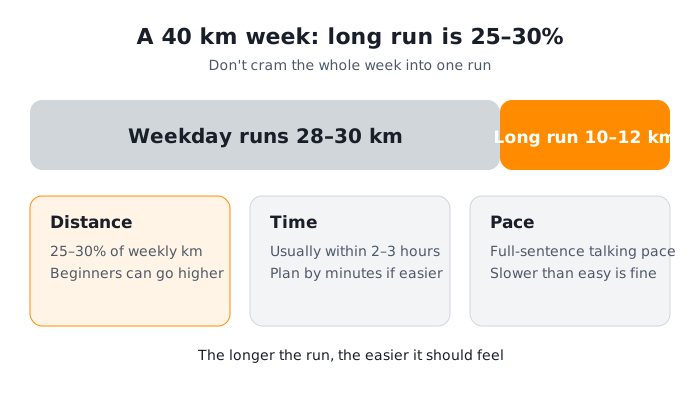
Time matters too. The Athletics Weekly article, citing research, puts the useful window at about 2–3 hours. It also advises runners slower than roughly 5:35 per km (9:00 per mile) to skip 32 km (20 mile) long runs.
💡 Tip
You can set the long run by time first. Start with 60 minutes, and if it ends comfortably, add 5–10 minutes next time.
3. Long Run Pace: A Pace You Can Chat At
Pace is easier to set by feel than by numbers. If you can speak in full sentences, that's your pace, and slower is fine. We covered how to find it in Easy Run Pace Guide: How Slow to Run and the 80/20 Rule.

- Start the first 1–2 km as a gentle jog
- Watch your breathing before your watch
- Speeding up late is fine, just don't force it
- Bring water and a snack once you pass 2 hours
Fueling matters on long runs too. See Fasted Running vs. Eating First: When and What to Eat Before and After a Run for before-and-after ideas.

If you're out of breath, drop one gear. Finishing at the same pace is the win!
4. How Fast to Build: Progression and Recovery Weeks
Add distance in small steps rather than big jumps. A systematic review of training load and running injuries by Damsted and colleagues (2018) found that runners who raised weekly distance by more than 30% tended to have more injuries than those who raised it by under 10%, though the result wasn't statistically firm (hazard ratio 1.59, 95% CI 0.96–2.66). A 10% and a 24% increase didn't differ, and the authors called the evidence very limited.
| Week | Example long run | Feel |
|---|---|---|
| 1 | 8 km (5 mi) | Easy |
| 2 | 9 km (5.6 mi) | A bit longer |
| 3 | 10 km (6.2 mi) | Longest |
| 4 | 7 km (4.3 mi) | Recovery week |
This table is an example from the Wittiz team, not a research-proven formula. If it felt easy, step up in the next cycle, and if it felt hard, repeat the same cycle once more.
⚠️ Caution
Stop and see a doctor if you feel chest pain, dizziness, cold sweats, or unusual shortness of breath. If you have heart disease, high blood pressure, diabetes, are pregnant, or have had joint surgery, check with a medical professional before adding distance. If pain makes it hard to put weight on a leg, or swelling and heat persist, rest and read the guide to running injury-free for the long haul.

The long run is the anchor of your week. In the Wittiz app, set a weekend goal like "one long run this week," then check in the report how much longer you went than last week. The jelly you earn from every run lets you dress up Moongti. If you're training for a half, pair this with the Half Marathon Training: A 12-Week Plan from 10K to 21.1 km.

Rest well after a long run. Rest days count as training too!
Frequently Asked Questions (FAQ)
How often should I do LSD training?
Once a week is enough for most runners. Long runs are demanding, so avoid doing them on back-to-back days. Rest or jog very lightly the next day.
How many km should my first long run be?
Start from the longest distance you can currently run comfortably. With 20 km a week that's about 5–6 km, and with 15 km over three runs about 6 km. If distance feels hard to pick, choose a time first.
What pace should my long run be?
Go by a talking pace. Numbers vary a lot between runners, so no single value fits everyone. If you feel out of breath late in the run, slow down.
Wrap-Up
A long run is about 25–30% of your week, at a talking pace, built up in small steps. Keep that one day easy and your race prep gets much steadier.
This week, try running 5–10 minutes longer than last week. Moongti will run beside you at the same easy pace, all the way to the end!
Try it for yourself in the Wittiz app!

References
- Damsted C, Glad S, Nielsen RO, Sørensen H, Malisoux L. (2018). Is there evidence for an association between changes in training load and running-related injuries? A systematic review. International Journal of Sports Physical Therapy
- Athletics Weekly. Marathon training: The long run - how far?
- Strength Running. How long should my long run be relative to my weekly mileage?
This article was written by the Wittiz team and includes app-related content. If you have pain or a medical condition, or feel unwell while running, please be sure to consult a medical professional.