
Increasing Running Distance: One Sudden Long Run Can Raise Your Injury Risk
💡 Key Summary
✅ Compare today's run with the longest run you've done in the past 30 days
✅ One study found higher injury risk when a run beat that longest run by more than 10%
✅ Pain, swelling, or warmth that lasts over 2 weeks means rest and a doctor visit
Autumn race season is over, and it's tempting to think, "Maybe I can go longer now." But plenty of runners have felt a knee or foot complain after one overexcited day. This post is for runners who are about to increase their running distance and want a simple rule for how much is okay (information checked as of November 2026).
1. Do running injuries build up slowly, or happen in one day?
In early November, a Korean daily's health column made a point of saying the problem isn't running itself but running too much too soon. It described young runners who joined the running boom and raised their distance without preparing, with knee injuries on the rise. Each stride sends roughly 4–6 times your body weight through your knees and ankles, the column noted.

Researchers at Aarhus University in Denmark looked at this directly. They analyzed about 588,000 runs logged over 18 months by 5,205 runners in 87 countries. Many injuries came from one day when a runner suddenly went much longer, not from slow build-up.

Same weekly total, but cramming it into one day can still shock your body.
For every run, the team compared the distance with the longest run in the previous 30 days. Runs that beat that longest run by 10–30% came with 64% higher injury risk, and runs more than double it carried more than twice the risk. This was an observational study, so it can't prove cause. Injuries were reported by the runners themselves, and most participants were middle-aged recreational runners, so it may not fit everyone.
2. How to increase running distance: a traffic-light rule
The rule is simple. Compare today's planned distance with your longest run in the past month. Splitting it into green, yellow, and red makes it easy to remember.
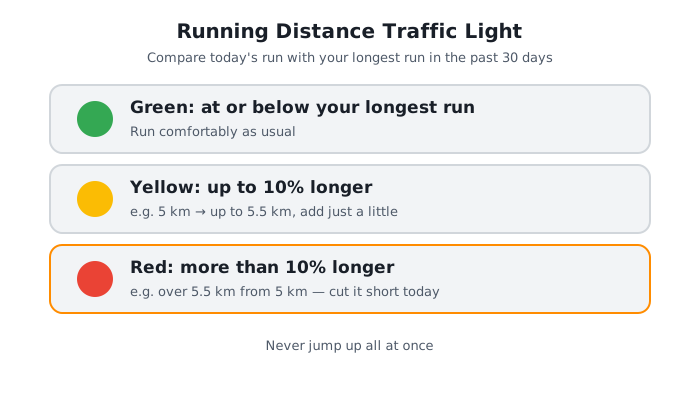
In the study, runs up to 10% longer made up the comparison group (the safest side). Even 1–10% increases showed a little extra risk, so adding a little at a time is the calmer way to go.
| Longest run, past month | Yellow (just a little) | Red (not today) |
|---|---|---|
| 3 km (1.9 mi) | up to 3.3 km | over 3.3 km |
| 5 km (3.1 mi) | up to 5.5 km | over 5.5 km |
| 10 km (6.2 mi) | up to 11 km | over 11 km |
The old rule of raising weekly mileage by about 10% (see our running injury prevention guide) still helps. Think of this traffic light not as a replacement but as a second daily check. For building long runs slowly, see our LSD long run guide.
💡 Tip
After time off, your longest run in the past month may be short. Start again from what feels easy now, not from last month's numbers.
3. Signals your body sends after you add distance
Feeling a little stiff the day after adding distance is common. But pain that keeps growing, or doesn't improve after days of rest, may be a warning. Korea's health agency (KDCA) also advises against raising exercise volume suddenly and building up gradually to match your fitness.

| How it feels | What to try |
|---|---|
| Mild stiffness | Easy run or walk to loosen up |
| One spot keeps hurting | Cut distance and rest |
| Pain past 2 weeks of rest | See a sports medicine doctor |

Running through pain means a longer break later. Let's rest today!
⚠️ Caution
Stop running and see a doctor if pain lasts over 2 weeks despite rest, your knee swells or feels hot, it catches or gives way, or it hurts at night. Pain that makes it hard to put weight on the leg counts too. If something is already sore, our plantar fasciitis guide for runners may help.
4. Planning this week's distance
Three things to do today. Check your longest run in the past month in your records. Keep this week's longest run within 10% of it. Keep the other days shorter.
| Day | Distance plan (longest run 5 km) |
|---|---|
| Tue | 3 km easy |
| Thu | 4 km easy |
| Sat | up to 5.5 km, slowly |
The Wittiz app is a more fun and smarter running app. Check your longest run from the past month in your records, then set this week's goal just a little above it.
Open the weekly report on the weekend to see whether any day jumped suddenly. You can spend the jelly you earn dressing up Moongti, too. If you're coming back after a break, start with our guide to restarting running.

Small steps still go far. Let's go slow together!
Frequently Asked Questions (FAQ)
How much can I increase my running distance per week?
There's no single exact number, but one handy rule is not to run more than 10% beyond your longest run of the past month on any given day. Treat the weekly 10% rule as a reference only. If your body feels heavy, holding your distance this week is fine.
Why does my knee hurt after suddenly increasing my running distance?
Each stride puts several times your body weight through the knee, over and over. If distance jumps suddenly, joints and muscles may not have time to adapt. See a doctor if pain lasts more than 2 weeks.
How do I build distance back up after a running injury?
Check that you can walk without pain, then return with short jogs. Don't jump distance up all at once; alternate with easy days and build slowly. If you're unsure when to return, ask a medical professional.
Wrap-up
The key to increasing your running distance is comparing today's run with your longest run in the past month.
This week, just check your longest run once in your records. Moongti will jog slowly right beside you!
Try it for yourself in the Wittiz app!
References
- Aarhus University. Everything we thought about running injury development was wrong, study shows
- Lindman I, Nielsen RØ. (2025). How much running is too much? A new take on injury risk for runners. BJSM Blog
- Korea Disease Control and Prevention Agency. Plantar fasciitis (running and exercise injury prevention)
- Financial News (Korea). Does running wear out your knees? The problem is overdoing it
This article was written by the Wittiz team and includes app-related content. If you have pain or a medical condition, please don't push yourself and be sure to consult a medical professional.