
Winter Running Training: Build Your Base Instead of Chasing PRs
💡 Key Summary
✅ Winter is the season for easy miles and a stronger aerobic base, not PRs
✅ On cold days, set effort by talking pace instead of watch numbers
✅ Add only 5–10% to weekly distance, and use the treadmill on icy or bitter days
The temperature drops and you wonder, "Should I still be chasing faster times?" The same pace suddenly feels harder, and it's easy to think your fitness is slipping. This guide is for runners figuring out how to approach winter running training, covering effort, a three-month plan, and when to move indoors.
1. Why Winter Running Training Is About Base, Not Speed
Canada's Running Magazine calls winter one of the best times to build an aerobic base, because the weather nudges you toward easy running. Building mileage mostly with easy runs is what coaches call base building.

Cold does put extra load on your body. The same magazine explains that cold narrows blood vessels, which can raise heart rate at the same pace. A 1991 review in Sports Medicine on exercise physiology in the cold also noted that lactate levels are generally higher during exercise and that breathing volume rises a lot at first exposure to cold air.
| Spring and fall | Winter | |
|---|---|---|
| Same pace | Feels easy | Can feel harder |
| Goal | Chase times | Build your base |
| Main work | Speed, races | Easy runs, long run |
So a slower winter pace doesn't mean you lost fitness. Your body may simply be spending more energy on staying warm. The table is the Wittiz team's summary of the two sources.

In winter, watch your breathing, not your watch. If you can chat, today counts!
2. On Cold Days, Set Effort by Feel
Running Magazine advises running by effort rather than pace in the cold. That means letting your watch show whatever pace it shows. Forcing pace in cold weather tends to bring fatigue without much training benefit.

The rule is simple: if you can talk in full sentences, you're at the right effort. To find your easy pace, see Easy Run Pace Guide: How Slow to Run and the 80/20 Rule.
| Situation | What to do |
|---|---|
| Breathing harder than usual | Slow down a notch |
| Chest feels tight or burning | Cut distance, cover mouth and nose |
| Slippery footing | Go short or move indoors |
| Body won't loosen up | Walk-jog the first 10 minutes |
💡 Tip
If cold air makes your chest sting, loosely cover your neck and mouth with a neck gaiter. For more on cold air and breathing tips, see Running in Cold Weather: Is Cold Air Bad for Your Lungs?.
3. A Three-Month Winter Base-Building Plan
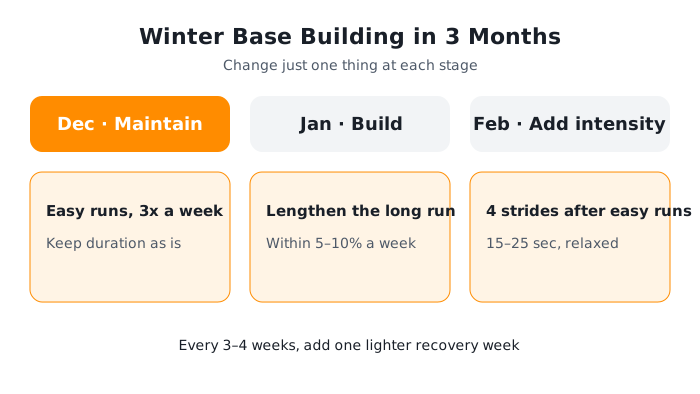
Fleet Feet advises raising weekly mileage by no more than 5–10% a week during base building, with a lighter recovery week every 3–4 weeks. It says most runners need just one long run and one speed session a week, with easy miles on the other days. Speed work can start as short strides: 4–8 reps of 15–25 seconds each.
How fast you add distance matters too. A 2018 systematic review by Damsted and colleagues found that runners who raised weekly distance by more than 30% tended to have a higher injury risk than those who raised it by under 10% (hazard ratio 1.59, 95% CI 0.96–2.66, so not statistically conclusive). There was no difference between 10% and 24% increases, and the authors called the evidence very limited.
| Month | Goal | Example work |
|---|---|---|
| December | Maintain | Easy runs, 3x a week |
| January | Build | Lengthen the long run slowly |
| February | Add intensity | 4 strides after easy runs |
This table is an example from the Wittiz team, not a research-proven plan. For the basics of staying healthy, pair it with How to Run for the Long Haul Injury-Free: From Preventing Knee Pain to Recovery.

Just stepping outside on a cold day is half the win. Keep it short today!
4. Mix In Treadmill Runs on Bitter or Icy Days
Running Magazine suggests that in extreme conditions you can use a treadmill, shorten the long run, or skip speed work. That's not about giving up outdoor running, it's about choosing by the weather.
| Weather | Good choice | Why |
|---|---|---|
| Clear and chilly | Easy outdoor run | Right clothes are enough |
| Bitter wind | Short outdoor or treadmill | Wind chill is low |
| Ice or packed snow | Treadmill or walking | Avoid slips |
Use What to Wear Running by Temperature: A Guide from 15°C Down to −10°C to pick your layers. On the treadmill, filling the time at an easy effort is enough.
⚠️ Caution
If you have asthma, cough or wheeze in cold air, or have heart disease or high blood pressure, talk to a medical professional before raising your winter intensity. Stop right away and get checked if you feel chest pain, dizziness, a cold sweat, or unusual shortness of breath. The same goes for pain that keeps you from putting weight on a leg, or swelling, after a fall on ice.
In winter, a number-of-runs goal is easier to keep than a distance goal. In the Wittiz app, set a goal like "3 easy runs this week" and log your indoor runs too. The jelly you earn lets you dress up Moongti, which gives you one more reason to head out on a cold day.
For help keeping it going, try the Want to Make Running a Habit? A No-Quit 30-Day Plan for Beginners.

If it's freezing and you feel heavy, rest is okay. Rest is training too!
Frequently Asked Questions (FAQ)
How many times a week should I do winter running training?
Keeping your current frequency is enough. Two or three easy runs plus one long run is a good base-building pattern. In very cold weeks, keep the number of runs and shorten the time.
Is it normal for my pace to slow down in the cold?
It can be. Cold can make the same pace feel harder, so match talking effort rather than watch numbers. If it stays too hard for weeks, check your rest and sleep as well.
Should I skip speed work entirely in winter?
You don't have to. A light touch, like 4–8 strides of 15–25 seconds after an easy run, is described as fine. Skip it on slippery days or when you're unwell.
Wrapping Up
The core of winter running training is steadily stacking easy miles, not chasing times. Set effort by feel and add distance slowly, and spring running will feel much lighter.
This week, run 20 minutes at a talking pace with no watch. Moongti will wear gloves and run right beside you!
Try it for yourself in the Wittiz app!

References
- Damsted C, Glad S, Nielsen RO, Sørensen H, Malisoux L. (2018). Is there evidence for an association between changes in training load and running-related injuries? A systematic review. International Journal of Sports Physical Therapy
- Doubt TJ. (1991). Physiology of exercise in the cold. Sports Medicine
- Running Magazine. How to make winter running feel less hard
- Fleet Feet. Build a Solid Base
This article was written by the Wittiz team and includes app-related content. If you have pain or a medical condition, or feel unwell while running, please be sure to consult a medical professional.